CS Leadership & Team Building
I Don't Hire the Most Experienced CSM. I Hire the Person Who's Lived the Customer's Job.
 Nina Wilkinson
 Nina Wilkinson
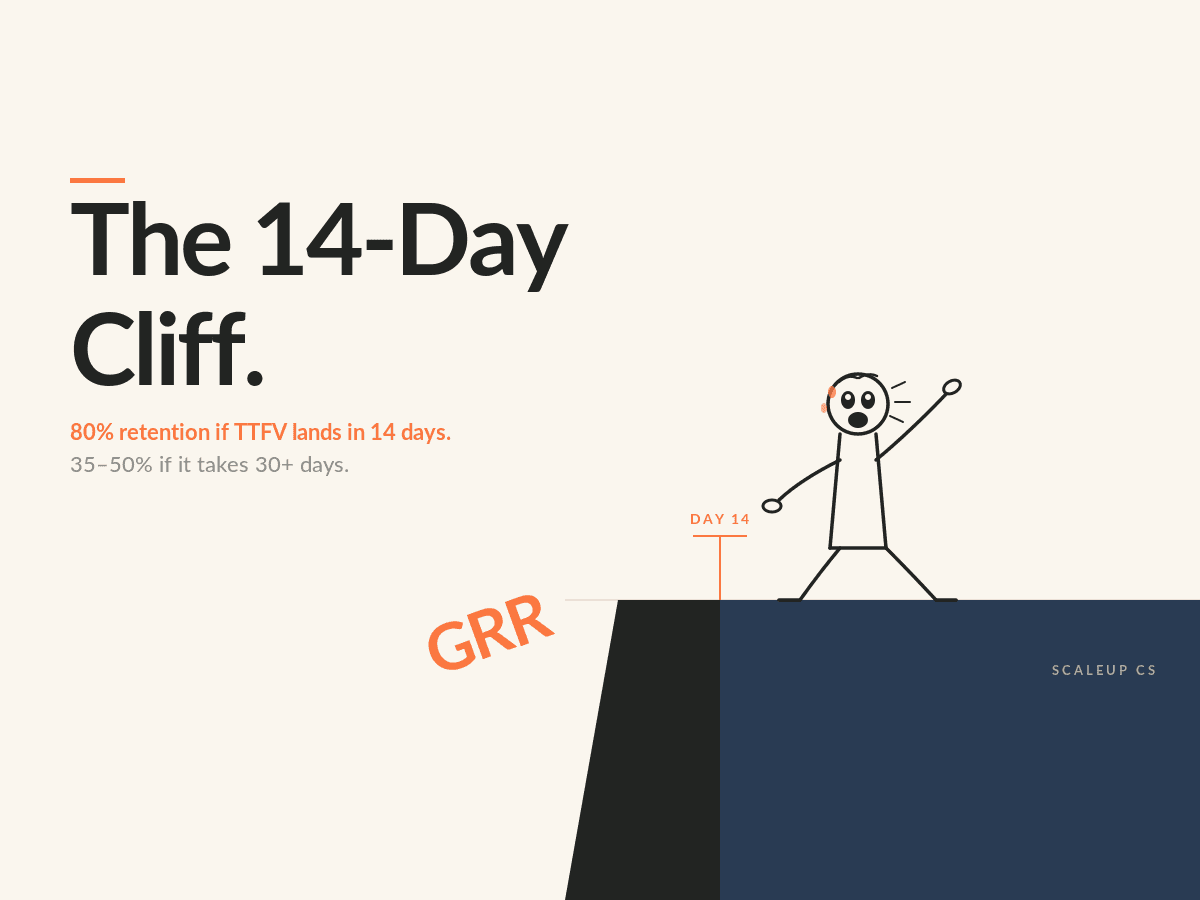
SaaS customers who realize first value within 14 days retain at 80%+ through month 12. Customers who take longer than 30 days drop to 35–50%. The difference isn't product complexity. It's a fixable set of structural problems, starting with how your team defines activation. A tactical breakdown of what a real activation event looks like, why withering customer engagement kills time-to-value, and how to sprint your customers to first value before the window closes.
Here is the number that has been reshaping how I think about onboarding.
B2B SaaS customers who realize first value within 14 days of signing retain at 80%+ through month 12. Customers who take over 30 days? That retention rate splits down to 35–50%.
That is not a marginal difference. That is a completely different business outcome, determined in a window most CS teams are not even measuring with precision.
The 90-day churn problem people talk about is almost never a 90-day problem. By the time it surfaces, the damage was done in week one or week two, quietly, while everyone assumed onboarding was "on track." I call it the 14-Day Cliff.
Most SaaS companies have a completion checklist for onboarding. The customer attended the kickoff call (checked). They completed training (checked). They logged in at least once in week two (checked). Dashboard is populated (checked). Onboarding closed.
That checklist is measuring your team's activity, not the customer's outcome.
One of our clients, as we were building out their onboarding flow, kept referring to onboarding as completed when they hit their product milestones (set up, aha, habit). But that's not when onboarding is done. Those are internal product milestones that we reference when tracking product adoption. Those milestones, while relevant from a product consumption standpoint, are meaningless to the customer. You need to redefine your activation metrics against an ROI Anchor. That anchor answers the only question that actually matters to your customer: "did this tool solve my problem?"
This is the distinction I push on with every founder who comes to us frustrated about 90-day churn. Their activation metric is a completion event, not a value event. The customer "finished" onboarding but never actually experienced the outcome they purchased.
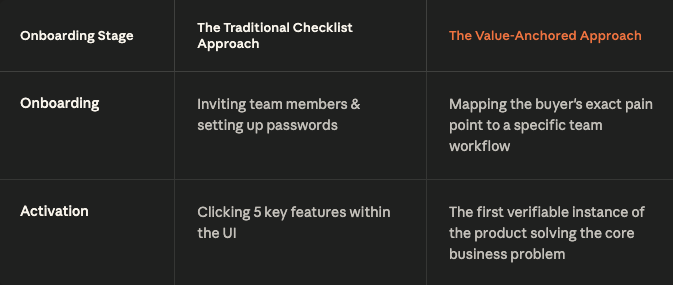
The right activation event is defined backwards from the renewal conversation, not forward from the kickoff call.
Ask yourself: at renewal, what is the one piece of evidence that would make the customer say yes without hesitation? Not "they used the product." Not "they attended QBRs." What specific, measurable outcome happened in their business because of your product?
That outcome is your activation event.
For some products it's a data output. For others it's a workflow that a team is running on autopilot. For others it's a cost that disappeared or a metric that moved. Whatever it is, it needs to be specific enough that your customer can point to it and say: that happened, and that is why this works for us.
If you cannot name it with that level of precision, you do not have an activation event yet. You have a hypothesis. And you are measuring onboarding completion against a hypothesis while wondering why customers churn at month three.
Once you have the real activation event identified, your entire onboarding structure reorganizes around it. Not "cover the features," but "get the customer to this specific moment as fast as possible, and make sure they know when they have arrived."
Defining the right activation event is necessary. It's not sufficient.
The most common reason customers take 30, 60, or 90 days to reach first value has nothing to do with product complexity or implementation difficulty. It's withering customer engagement at the beginning of the relationship, and it's almost always caused by the same two structural failures.
The decision maker disappears after the contract is signed.
The person who championed your product internally, who fought for the budget, who had the clearest view of the problem being solved, is usually not the person in the kickoff call. They handed it off to their team, moved back to their other priorities, and assumed the implementation would run itself. When it hits a snag, nobody with organizational authority is in the room to unblock it. The day-to-day users go quiet because they are stuck, and the CSM is left chasing a thread that the decision maker would have resolved in one conversation.
I've run this play enough times to know: if the decision maker is not actively involved in weeks one and two, you are going to spend weeks three through six trying to get them back in the room.
The end users were not bought in from the kickoff call onward.
The other version of this problem is that the decision maker is engaged, but the people who actually need to use the product every day were not brought along from the start. They were told about the new tool, maybe they were in a training session, but they were not involved in shaping how it would fit into their workflow. So they are skeptical. They have their old process, they have their own priorities, and a new platform is friction to them, not a solution.
A kickoff call that does not address end user concerns directly, that does not surface the "what's in it for me" for the people doing the actual work, is a kickoff call that set up a slow engagement decline. The day-to-day users are the ones who will drive or kill activation. If they are not bought in from day one, your 14-day window is already closing.
This is the part of the conversation that makes some CS leaders uncomfortable, but it's the part that actually moves the metric.
Withering customer engagement in the first two weeks is not a customer problem. It's a process problem. And the fix is not patience. To beat the 14-Day Cliff, you have to establish commercial accountability from day one.
1. Mandate Decision-Maker Attendance at Kickoff.
Do not allow a kickoff call to happen without the economic buyer in the room. If they try to delegate it entirely to a junior administrator, push back. The kickoff call is not a technical training session. It's a strategic alignment meeting where the decision-maker must explicitly state their definition of success to the users who will be operating the software. Without that moment, you have a room full of people who do not fully understand why this project matters at the executive level, and no organizational authority to unblock anything when the first obstacle appears.
2. Build a Joint Execution Blueprint.
During the kickoff, establish a mutual plan that clearly outlines deadlines for the customer's team. If they do not upload their data by day 3, or if they miss the technical configuration window on day 5, your CSM needs to call it out immediately. Not in a punitive way, but in a direct one: here is what is at risk, here is what we need to get back on track.
You cannot be more committed to the customer's success than they are. Holding their feet to the fire early builds respect and ensures they treat your software as a priority project rather than a background experiment.
If the decision maker has gone quiet, the CSM should say it plainly: "We are at day eight and I do not have the access we need to hit your timeline. I need 20 minutes this week or we are going to push back first value by two weeks." That conversation is uncomfortable to initiate. But not having it is more expensive.
The mental model shift that matters most here is treating the first 14 days as a sprint with a defined finish line, not a schedule with activities on a calendar.
A sprint has a specific outcome it's running toward (the activation event), a clear set of blockers being tracked every day, and a team that knows the clock is running.
For the CS team, this means the TTV target is set before the kickoff call, not defined loosely after. It means the kickoff call ends with the customer repeating back what "first value" looks like for them, not just agreeing to a list of next steps. It means the CSM's weekly check-in is not "how is everything going" but "here is where we are against the timeline, here is what is at risk, here is what we need from your side this week."
And it means tracking TTV as a real metric in your CS platform, not as an afterthought in a QBR deck. If you are not measuring time to first value by cohort, you cannot see the cliff. And if you cannot see it, you are solving for symptoms, late-stage churn conversations, low product usage, missed QBRs, rather than the cause.
To turn this into a repeatable process that your team can execute across dozens of new accounts, you have to build it into your standard operating procedures.
Audit your true value milestone. Sit down with your product data and look at your best customers. What did they achieve in their first 30 days that your churned accounts did not? Find that exact business milestone and make it your team's North Star. Not the product milestone. The business outcome.
Train CSMs on soft accountability. Give your CSMs the scripting and confidence to handle friction when a customer misses an onboarding deadline. They need to know how to gently but firmly remind the client that delaying setup directly delays the ROI they promised their executive board. This is a skill. It does not come naturally to most CS hires who were trained to absorb, not push back.
Track TTV rigorously. If your average time-to-value stretches past 14 to 30 days, treat it as a red-alert metric. Bring it to your weekly leadership syncs and diagnose exactly where the implementation bottlenecks live. You cannot fix what you are not measuring, and most teams are not measuring this with nearly enough precision.
The 90-day churn problem is a 14-day problem that nobody caught in time.
Fix the activation event first. Define it backwards from the renewal, not forward from the checklist. Then sprint your customers toward that event, with the decision maker engaged and the end users bought in from the start.
The companies that get this right are not doing more elaborate onboarding programs. They are doing tighter, more intentional ones, with a specific outcome in their sights and the willingness to hold the customer to the timeline.
That is where the 80% retention number comes from. Not from doing more in the first 90 days. From doing the right thing in the first 14.