CS Leadership & Team Building
Sales–CS AlignmentRevenue & Business Case
The CRO's Guide to NRR: Aligning Sales and Customer Success for Seamless Handoffs and Expansion
May 5, 2026·7 min read
 Nina Wilkinson
The single most expensive moment in your revenue motion isn't the discovery call or the renewal. It's the gap between Closed Won and the first kickoff. The customer retells their story. The CSM ramps up cold. The expansion conversation gets quietly delayed. Here's the 7-field handoff framework we use with our clients to systematize the Sales-to-CS transition, plus the AI workflow that makes it actually run without burning out your AEs.
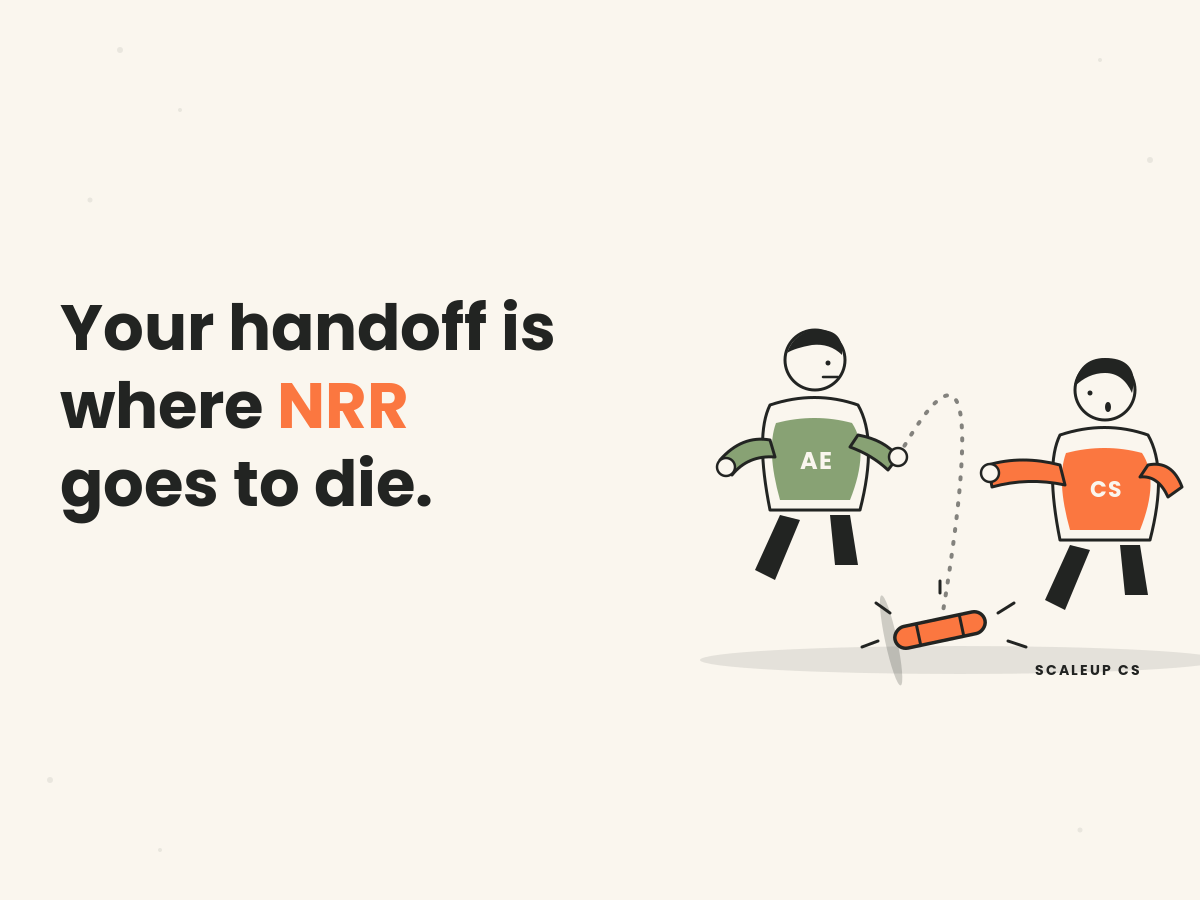
If you're a revenue leader and you want to understand where your NRR is leaking, look at the gap between when your AE shakes hands on the deal and when your CSM kicks off the customer.
That gap is the most expensive part of your revenue motion. And most companies don't measure it, don't own it, and don't fix it.
Picture this from the other side of the table. Your customer just spent two hours, sometimes more, walking your sales rep through their problem. They explained the messy internal politics, the failed prior solution, the metrics their CFO is going to ask about, the technical constraints, the team they're trying not to burn out. They sold themselves to your AE. They got to the point of trust where they signed a contract.
And then? They get an introduction email to a CSM and an onboarding manager they've never met. The first kickoff call opens with: "Tell me a little about your business and what you're hoping to accomplish."
The customer is doing the math in their head. I just did this. Why are we starting over?
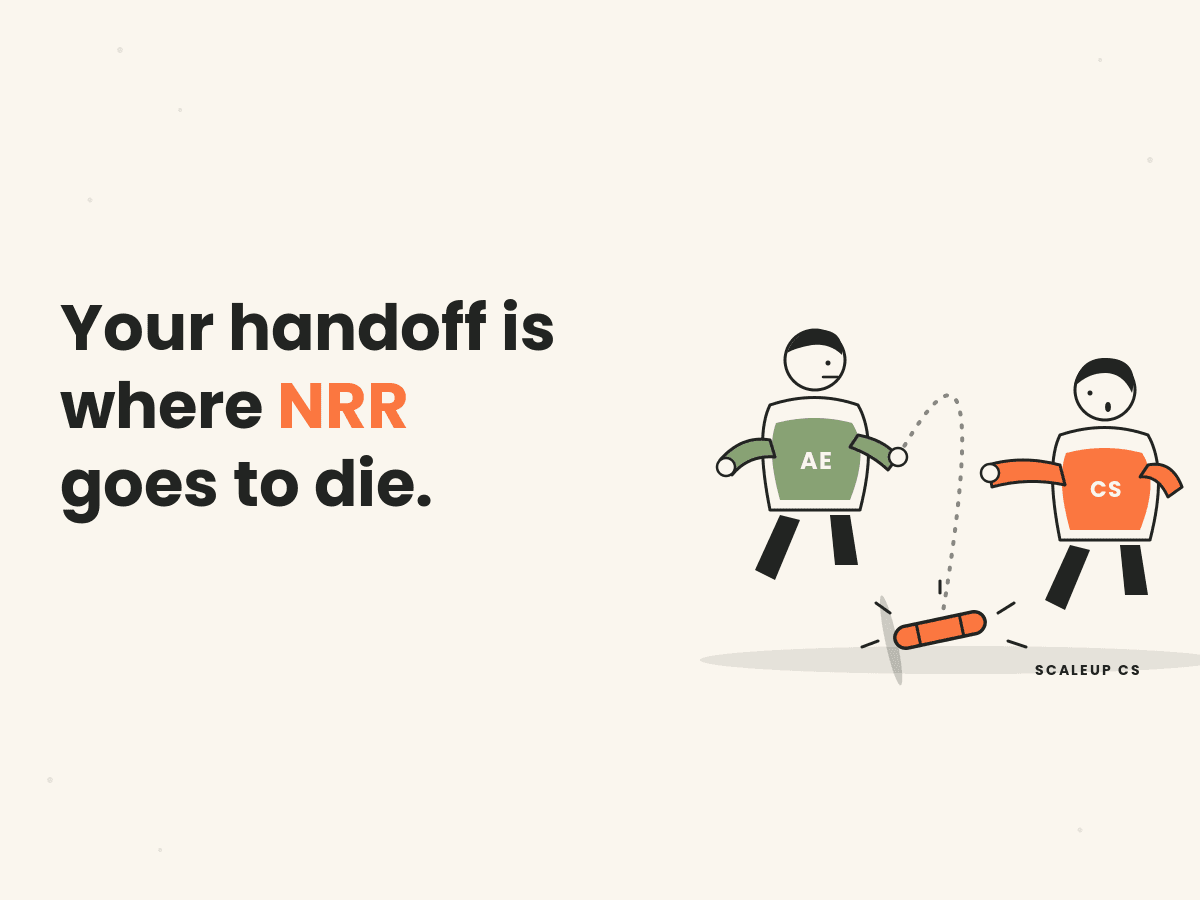
That moment, that one moment, is where every downstream NRR problem starts. The slow KO. The unfinished onboarding. The hesitancy to expand. The chargeback when an AE missed the implementation timeline. The quiet, two-quarters-later non-renewal.
This is the quarter to fix it.
Why this is the broken process that hurts your customer the most
Your sales team and your customer success team probably have separate Slack channels, separate KPIs, separate leadership, separate tooling stacks, and (often) separate compensation structures (see our post on ideal comp structures for CSMs). That's normal at scale. But your customer doesn't see any of that. They see one logo, one product, one promise.
When the handoff is bad, the customer experiences it as a broken brand promise. The energy of the sales process collapses into the friction of onboarding. They start to wonder if the company they bought from is the company that's now showing up.
And the cost is structural. A few things happen, predictably:
The kickoff call gets pushed because the CSM is "still ramping up on the account." That's two extra weeks of lost time-to-value.
The CSM asks the customer to re-explain their goals, which the customer interprets as: the AE didn't actually listen to me, or didn't bother passing it on. Trust takes a hit before the relationship even starts.
The implementation manager (or onboarding manager, depending on your nomenclature) hits a roadblock that the AE knew about during the deal cycle but never wrote down anywhere. The customer ends up frustrated, the IM/OM ends up apologizing, and the AE's number gets a chargeback two months later for "failure to onboard."
The first expansion conversation, the one your model relies on for NRR over 110%, gets quietly delayed because nobody on the post sales side has enough context to bring it up confidently.
None of this is the CSM's fault. None of it is the AE's fault. It's a systems problem, and the system is yours to design.
The fix is not a meeting. The fix is a document.
Most "handoff fixes" I see in the wild are the wrong shape. They're a 30-minute internal handoff call between the AE and the CSM, an unstructured Slack message, and maybe a Salesforce field that nobody fills in consistently. That's not a system. That's a hope.
The fix is to systematize the handoff into a structured document, generated automatically from the call recordings your sales team already has, and pushed into the tools your post sales team already uses, the moment the deal is marked Closed Won.
Here's what that document should contain.
The 7-part handoff summary every Closed Won deal should produce
This is the framework I use with our clients. It's seven fields, not seventy. The discipline is in keeping it tight enough that the AE can review it in five minutes and the CSM and IM/OM can absorb it in ten.
1. Customer problem. What is the actual business pain that drove the customer to buy? Not the feature they bought. The underlying problem. If your AE can't articulate this in three sentences, the deal closed for the wrong reasons and your retention is already at risk.
2. How your product solves that problem. The customer's mental model of how your product fits into their workflow. This matters because the CSM is going to anchor onboarding to this exact framing. If the framing is fuzzy, onboarding will be too.
3. Who this helps on the customer's side. Which roles, which teams, and what their day looks like before and after. This tells the CSM who needs to be in the kickoff and who needs to be enabled in week one versus week six.
4. Roadblocks and challenges. What internal politics, technical constraints, competing priorities, or resource gaps were surfaced during the sales cycle? These are the things that will derail onboarding if your post sales team doesn't see them coming.
5. Hardest part of onboarding for the customer. Be honest. Is it the data integration? The change management with their team? The fact that their executive sponsor is on parental leave for half of Q2? The CSM and IM/OM need to know this on day one, not week six.
6. Timelines they're up against. Their event, their board meeting, their budget cycle, the renewal date with the legacy tool they're replacing. If your CSM doesn't know the customer's clock, they can't run a project plan against it.
7. Key people. Decision maker, day-to-day user, stakeholders, technical contacts. Names, titles, and a one-line note on each. Especially the day-to-day user, because that's the person whose adoption will determine renewal.
That's it. Seven fields. Captured once. Pushed everywhere.
How AI lets you actually run this without burning out your AEs
I know what you're thinking. My AEs already complain about admin work. There's no way they're going to fill out a structured 7-field document on every Closed Won deal.
You're right. They won't. And they shouldn't have to.
This is where AI changes the math. Your sales team is already recording their calls. The signal is already in your stack. The 7-field summary should be generated automatically from those recordings the moment a deal moves to Closed Won, then pushed in the right shape to the right tools:
The full structured 7-field summary goes into the CRM as a new section on the account record, so the CSM has it the moment they're assigned.
The same summary syncs into the customer success platform (Vitally, Gainsight, PlanHat, whatever your stack), so the CSM's customer view opens with full context.
A condensed version, just the customer problem, the hardest onboarding part, the timelines, and the key people, posts into a dedicated Slack channel so the broader CS, IM/OM, and product teams have visibility from day one.
You can build this with Claude or any modern LLM and a thin orchestration layer. We've stood up versions of this in client engagements where the AE's "homework" after a Closed Won is reduced to reviewing the AI-drafted summary, fixing anything wrong, and clicking approve.
Total time per deal: under five minutes. The CSM gets a complete brief instead of a vague Slack message.
Sales sells the dream. CS delivers on the reality. The handoff document is what makes sure the dream and the reality match.
This is the workflow that earns its keep three different ways at once.
What you actually get when you fix the handoff
When the handoff is systematized, three things change measurably for your revenue org.
Faster speed-to-handoff and faster kickoff. When the CSM has the full 7-field summary on day one, the kickoff call gets booked the same week. We've seen clients shrink their average time-to-kickoff from 14 days to under 5. That's nine days of additional time-to-value for the customer, and nine days of risk you've removed from the renewal forecast.
Fewer chargebacks to your AEs. The number one cause of post-Closed-Won chargebacks I see is some variation of "AE oversold" or "AE missed a known constraint that surfaced in implementation." Most of the time, the AE didn't oversell. The dream they sold was real. They just didn't transfer the context CS needed to deliver on the reality. A structured handoff document is the cleanest possible audit trail. The AE wrote it down, the CSM/IM acknowledged it. If something surfaces later that wasn't in the doc, it's a real edge case, not a sales-team-versus-CS-team finger-pointing exercise.
Lower failure-to-onboard rates and stronger first-expansion alignment. This is the one your CFO will care about. Customers who complete onboarding faster, with better context, expand sooner. Your CSM walks into the first QBR with the customer's actual problem fresh in their mind and the metrics that matter to that customer's exec team already mapped. You're not building expansion velocity from scratch in month four. You're carrying the sales team's momentum into the first expansion conversation.
What this looks like as a revenue leader's playbook
If you want to fix this in Q3, here's the order of operations:
Start with one stage gate: no deal is marked Closed Won until the 7-field summary exists on the account record. That single rule changes the AE behavior immediately, even before any AI tooling.
Stand up the AI workflow next. Pick the one customer cohort where the handoff hurts most (probably your enterprise tier, or whatever segment carries the highest CAC), and run the automation there first. Measure time-to-kickoff before and after.
Once the workflow is producing reliable summaries, push the integration into the tools your CS team already lives in. Don't ask them to learn a new system. Bring the handoff to where they already work.
Finally, pull the metric into your weekly revenue review. Time-to-handoff and time-to-kickoff should sit next to pipeline coverage and ARR attainment. If you don't measure it, it won't get fixed.
The bottom line
The Sales-to-CS handoff is the most under-managed part of your revenue motion and the highest-leverage thing you can fix in the next 90 days. The customer feels it most. Your CSMs and IMs feel it daily. Your AEs eat the chargebacks. Your NRR pays the bill.
Stop running it as a 30-minute meeting. Start running it as a 7-field document, automatically generated, pushed everywhere it needs to go.
Your customer already sold themselves to your sales team. Don't make them sell again.