CS Leadership & Team Building
CS Leadership & Team BuildingOnboarding & Adoption
Founding CSMs: How to Succeed as Your Startup’s First CSM
December 1, 2025·10 min read
 Nina Wilkinson
Your first CS hire can make or break early customer success. Discover the Swiss Army knife traits to hire for, the pitfalls to avoid, and what real Year 1 success looks like—from a founding CSM who survived the chaos.
I'll never forget my first week as a founding CSM at a seed stage startup. Outside of the founding team, I was the first US hire at the company. I was in SF, the team was in Tel Aviv, we had no office and we were still trying to figure out our product market fit. We had customers globally but no formal process for anything, onboarding, renewals, you name it. No playbook. No customer segmentation. No CRM hygiene (I don’t think we even had a CRM at that point, 👋🏽 GSheets). Just me, a laptop, and a growing sense that I was either about to build something incredible or spectacularly fail.
Spoiler: I did both—sometimes in the same week.
It was probably the craziest job opportunity I ever took, and I’m forever grateful for it, as it was the best CS education I could have asked for.
If you're reading this as a founding CSM (or you're a CEO trying to figure out what success actually looks like for your first customer success hire), this post is for you. I've been in the trenches (we don’t call this blog Tuesday in the Trenches for nothing 😉), I've made the mistakes, and I've also seen what separates founding CSMs who become revenue-driving forces from those who burn out in six months.
In this post, I’ll break down what a successful founding CSM actually does, who is the right fit for a first CS hire, and what to absolutely avoid in those crucial early days.
We’ll cover:
What a founding CSM really is (and isn’t)
Why you need a Swiss Army knife, not a specialist
Why “doing things that don’t scale” is your CS superpower
How to think about goals in Year 1
Why flexibility is non-negotiable
How communication makes or breaks your impact
So What Is A Founding CSM, Really?
Let’s get clear on language. A founding CSM is not just “the first person we hired to talk to customers.”
A true founding CSM is:
The first line of defense against churn
The translator between customers and product
The person quietly building the playbook while running the play
The human feedback loop for your PLG motion
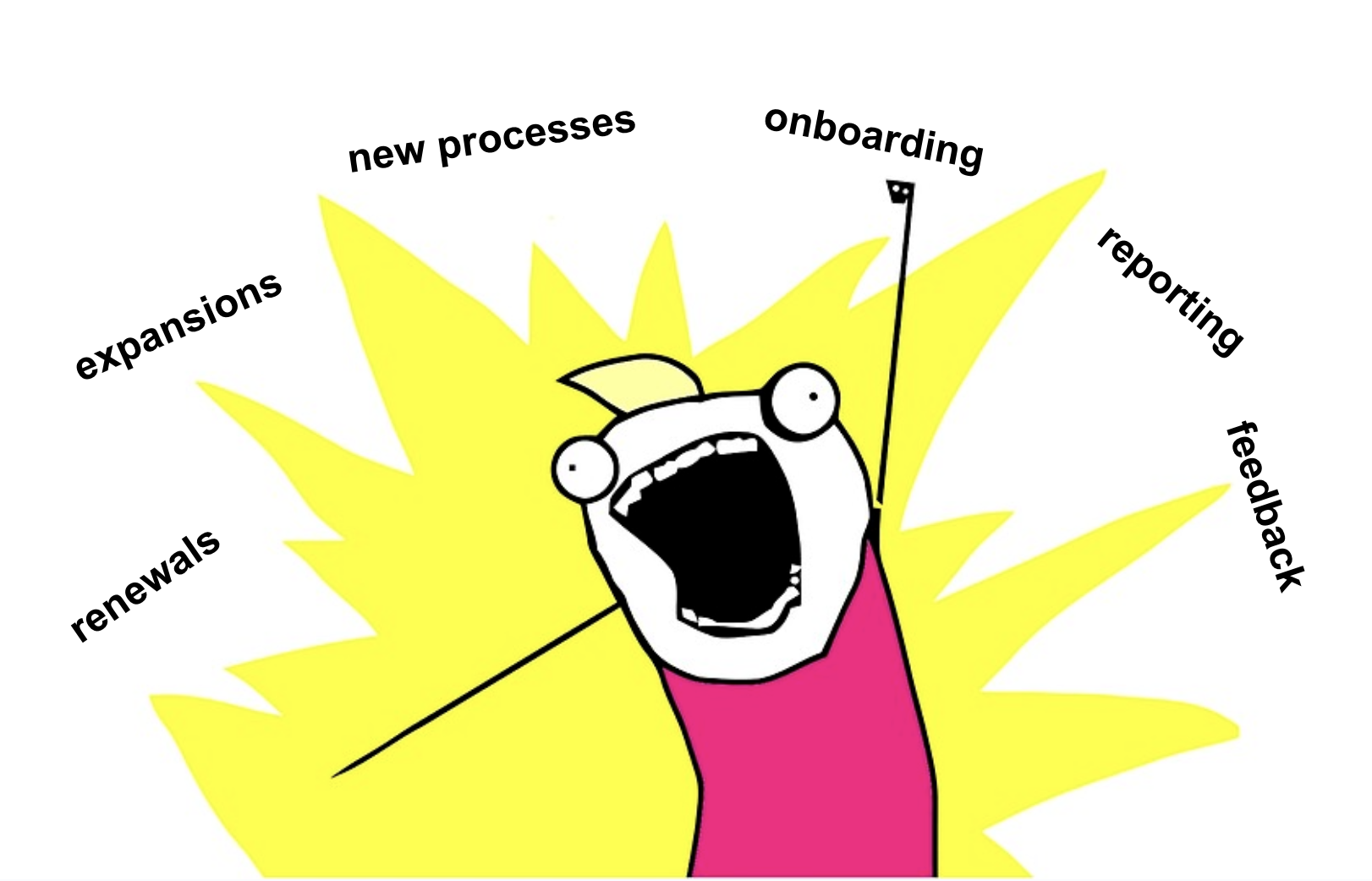
If you’re asking, “What does a founding CSM do?” the honest answer is: a bit of everything. One day you're running onboarding calls. The next, you're building a renewal dashboard. The next, you're triaging a product bug with Engineering. Then you're mapping out customer journey stages. Then you're on a call with your CEO explaining why a customer churned. Oh and you’re documenting all the things, boy oh boy do you document. As a founding CSM, you will wear approximately 47 hats. If you need a narrow, well-defined job description to thrive, this role is not for you. Successful founding CSMs are energized by variety. They're comfortable context-switching. They don't get paralyzed by ambiguity.
If you’re a founder, this is why your first CS hire is so critical. If you get this wrong, you don’t just “miss on one hire” — you delay learning from customers, you slow down product-market fit, and you risk burning your earliest champions. We broke down when and who to hire in more depth here but the TLDR:
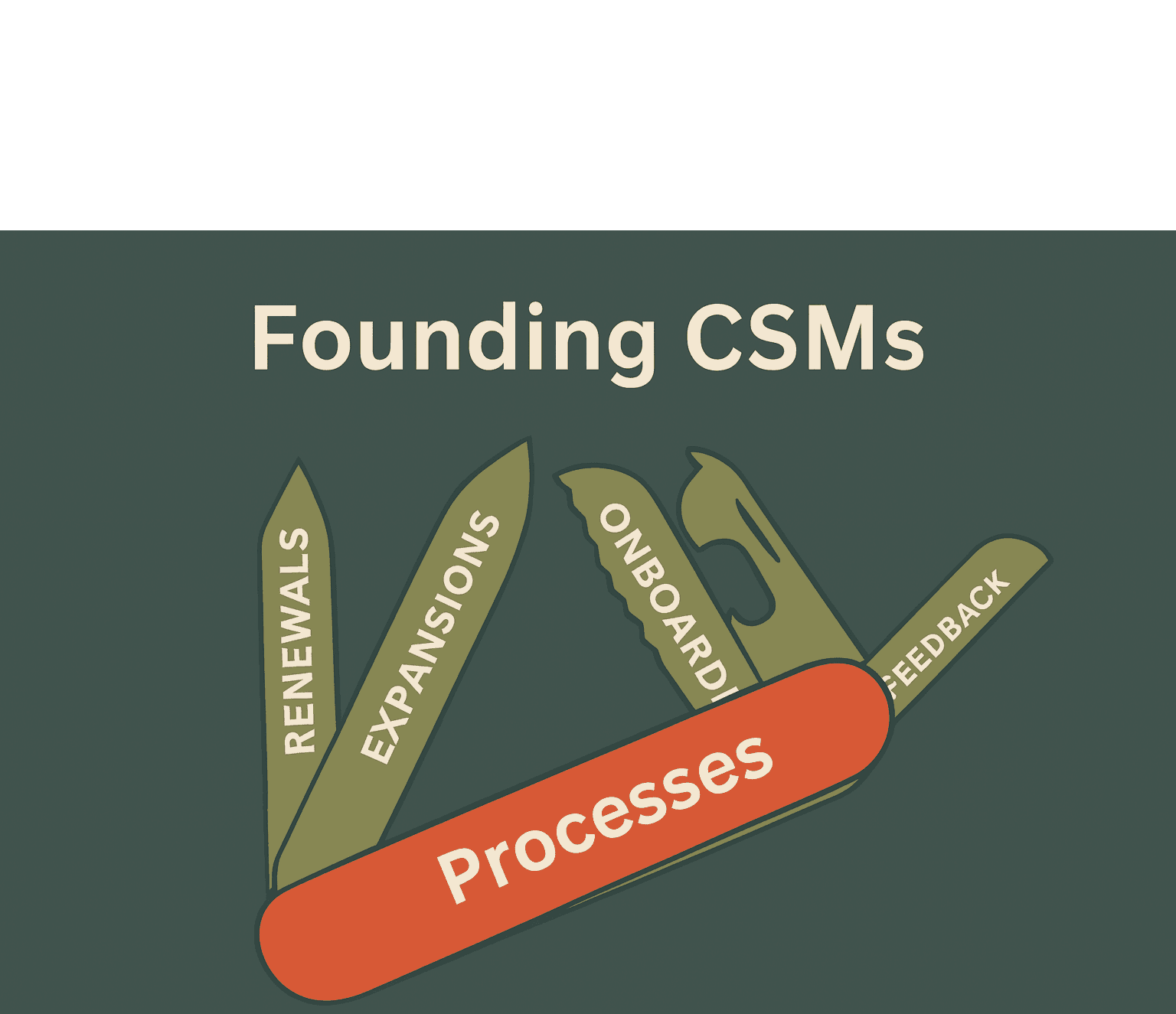
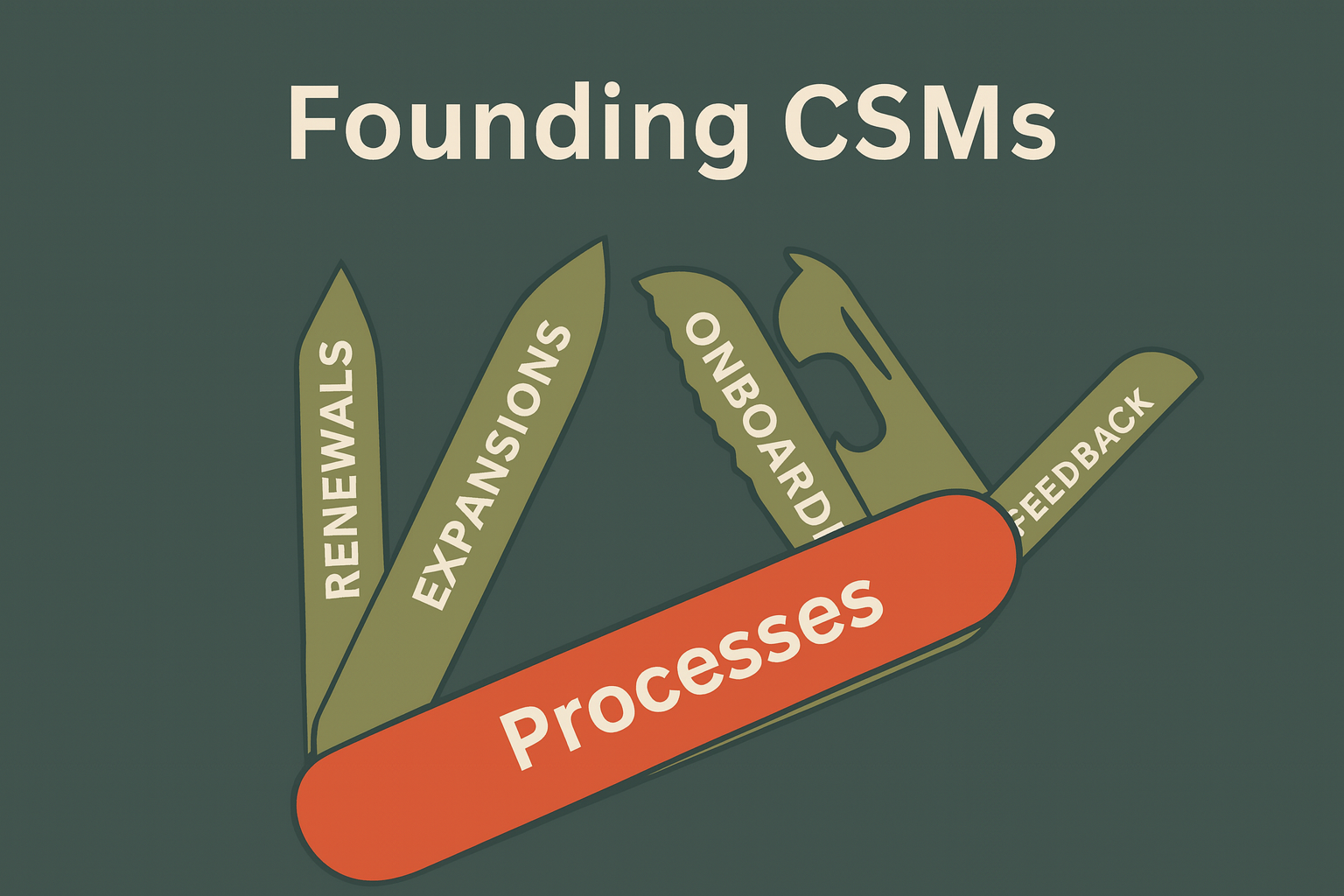
You’re Hiring A Swiss Army Knife, Not A Specialist
The biggest mistake I see? Hiring either:
A pure “relationship person” who avoids revenue conversations, or
A process-obsessed ops person who never actually builds trust with customers
Your founding CSM has to be both strategic and scrappy — a Swiss Army knife, not a single-purpose tool.
Here’s the profile that tends to win as a first CS hire / founding CSM in an early-stage, PLG-ish SaaS company:
3–6 years in a customer-facing role
You don't need someone who's managed a CS team. You need someone who's done the work—onboarding customers, managing renewals, handling escalations, identifying upsell opportunities. They have enough experience to juggle onboarding, renewals, and expansion without hand-holding. They might come from Customer Success, Account Management, or Solutions Consulting.
Hands-on onboarding experience
This is non-negotiable. They’ve actually designed and run onboarding programs — not just inherited them. They know how to get a customer to their “aha moment” quickly and repeatably. If they've only worked in mature CS orgs where onboarding was already built, they'll struggle here.
Comfortable with a revenue number
Founding CSMs are part of the revenue engine. They should be comfortable having expansion and renewal conversations, even if the sale is “light-touch.” This person is a crucial part of your revenue engine, not just a "customer happiness" function.
Process-builder mindset
If someone only thrives in a polished enterprise environment with defined playbooks and a CS ops team, they will struggle as a founding CSM. You need someone who’s okay building the plane while flying it. Look for someone who gets energized by creating structure from chaos—not someone who shuts down when the process doesn't exist yet.
Emotionally okay with ambiguity
Early stage means unclear boundaries. One day you’re doing onboarding, the next you’re QA’ing a feature or jumping into a support queue. If that sounds like a nightmare to them, they’re not your founding CSM.
What to avoid:
Hiring someone who only wants to “manage a book of business” but not build anything
Hiring someone who has never touched onboarding and only done renewals
Hiring someone who panics when two or three things are on fire at once
Founding CSMs need multiple pots on the stove — and they can keep them from boiling over.
Do The Things That Don't Scale (On Purpose)
This is the time to over-invest in your customers.
If you’re a founding CSM, that means:
White-glove onboarding that's 90% human, 10% self-serve
Leading personalized check-ins with every customer in your book
Spending an hour on a call helping a customer solve a problem that only affects them (for now)
Recording custom Loom walkthroughs instead of waiting for a Help Center to exist
Asking “Why?” five times when a customer churns or expands
This doesn't scale. That's the point.
You're not building for 10,000 customers right now. You're building for your first 50–100. And those customers are going to teach you everything you need to know about what will scale later.
As a founding CSM, you need to over-invest in:
High-touch onboarding
Walk customers through the product. Watch where they get stuck. Take notes. These insights will eventually inform your help center, in-app guides, and product UX.
Deep discovery on every account
Understand the job-to-be-done, success metrics, internal politics, and how your product fits into their day. You’d be surprised at how much this will influence your ICP and which prospects your marketing and sales teams go after. The more effort you put in here, the more likely you are to to determine which customers are a good fit for your product/services and are more likely to renew. Think of this as the gift to your future self.
Narrative feedback
Don’t just say “customers are confused by the setup.” Bring specific examples, quotes, Loom videos, and patterns back to your product team and founders. Proof is in the pudding here. I remember one of our customers was trying to pay us, should be simple and straightforward right? Nope, it took them 20 minutes to get through our payment portal to pay us. Not good and painful for us and our customers. I recorded the experience, sent it to our product team, and said this has to be priority 1 in the next sprint. We can’t make it difficult to pay us.
The founding CSMs who succeed understand all this. They're sponges. They're learning customer pain points, use cases, onboarding friction, and renewal objections in real time—and they're documenting all of it so they can systematize later.
The ones who fail? They try to build scalable systems before they understand what actually needs to scale.
And founders, I know you often think: “We’re PLG; we need everything to be self-serve.” Eventually, yes. But early on, doing things that don’t scale is how you learn what should be self-serve later. You have to crawl before you can walk.
What Success Actually Looks Like in Year 1 (Hint: It's Not 120% NRR)
Let's talk about goals.
As a founding CSM, you're not going for Olympic gold here. You're not trying to hit 120%+ NRR in your first six months. You're not building a customer health score model that rivals Gainsight's enterprise setup.
You're aiming for operational foundations, not investor metrics.
Here's what success actually looks like at this stage:
✅ Did all of our newly signed customers go through onboarding this week?
Not "did we have a perfect onboarding experience?" Just: did everyone who signed get onboarded in a consistent, trackable way?
✅ Do we have visibility into our renewal pipeline?
Can you confidently tell your CEO which customers are renewing next quarter and what their risk level is? You don't need a fancy dashboard yet—a spreadsheet works. But you need visibility.
✅ Are we capturing customer feedback in a way that Product can actually use?
This doesn't mean a perfect feedback loop. It means: are you documenting customer pain points, feature requests, and use cases in a way that Product leadership can prioritize? Again, be scrappy here, loom videos are great, granola summaries are solid. Use those to help illustrate the customer experience for your cross functional friends.
✅ Do we know which customers are healthy vs. at-risk?
Again, this doesn't require a sophisticated health score. It requires a simple system (even if it's a manual GSheet (trust me, I love me a good GSheet)) that tracks usage, engagement, and stakeholder relationships.
✅ Are our initial renewal journeys mapped out and working?
Did you test your renewal process? Did customers actually respond to your outreach? A/B test your messaging and see what lands. Did you encounter blockers you didn't anticipate? Does your platform or billing system make it easy or difficult for you to renew your customers (your Product team ABSOLUTELY needs to know if there’s friction at the renewal point) This is about learning and iterating, not perfection.
Your goal in Year 1 is to build repeatable motions that don't break when you scale.
You're not optimizing yet. You're testing, learning, and documenting what works.
As a founding CSM, you should absolutely care about renewals and expansion, but your primary value is building a reliable customer engine — not just hitting a big NRR number once.
What to avoid:
Being judged solely on NRR in Year 1
If your founder’s only KPI for you is revenue, they’ll miss the real value you’re creating and might misjudge performance. All those points above speak to the value you’re delivering, you need to be confident and thorough in that when messaging upwards.
Ignoring the “plumbing”
If you don’t validate dashboards, journeys, and playbooks now, you’ll be flying blind when you hit $5-10M ARR and that is a really big hole to dig yourself out of.
Be Flexible: If You Need Perfect Structure, This Will Break You
Here’s the uncomfortable reality: founding CSMs live in chaos — the good kind and the bad kind.
Your day will rarely go the way you planned. You might start the morning prepared to run three onboarding sessions and end up:
Joining an emergency call with a renewal-risk customer
Jumping into a support queue because a bug is blowing up
Helping product test a feature before a launch
Writing a one-pager to help Sales close a key logo
If you thrive on order, rigid process, and knowing exactly what’s coming next, being a founding CSM at an early-stage, PLG-ish startup will feel exhausting.
Flexibility in this role means:
You can change priorities mid-day without melting down. And to be clear meltdowns happen, it’s ok, but from a mental health perspective, if you’re melting down everyday, this is not the job for you, and that’s ok. Know thyself, right?
You’re okay with goals shifting mid-quarter as the company learns. This should happen. You’ll learn things throughout the quarter and will need to pivot accordingly. Remember you’re a sailboat not a cruise ship.
You can hold two truths at once: “This process is messy” and “I’m still going to improve it”. It’s ok if the process is messy, at first it should be. Think about when you’re making dinner, if it’s a new recipe you’re trying, it takes you longer to make it because you’re re-reading the recipe, double checking your ingredients and making sure things don’t burn. If it’s something you make once a week, you don’t need the recipe, you know the steps, and you can run on autopilot to make it. Being a founding CSM is messy, but I guarantee the things you struggled with in Week 1 will be easier and faster by Week 6 and so on.
What to avoid:
Expecting a fully built CS playbook on Day 1. You are the playbook.
Getting attached to a single “right way” of doing things. At this stage, what worked at your last Series C company might not fit this product, market, or motion.
Your Secret Weapon: Communication That Connects
In a role defined by ambiguity, your ability to communicate with clarity and influence is everything. You can be amazing with customers, but if you can’t communicate effectively both externally and internally, your impact will be invisible.
As a founding CSM, communication is your unfair advantage if you use it well:
With customers:
Set expectations clearly: what’s in scope, what’s possible, what’s not
Explain timelines, tradeoffs, and workarounds without hiding behind jargon
Listen more than you talk, and mirror back what you heard to align on success
With product and engineering:
Clearly define the customer problem:
Not “they hate the UI,” but: “They can’t do X, which means they need to manually do Y every week, which is costing them Z.”
Bring the "Why":
Don't just say, "The customer wants a new integration." Explain the business problem: "Our top-paying user is struggling to consolidate their reporting, which is putting their renewal at risk. An integration would solve this and unlock a new use case for accounts like them."
Bring the Voice:
Use direct quotes, screen recordings, and real stories. Make the customer's pain impossible for your internal teams to ignore.
Think beyond one customer:
When you bring issues, frame them as patterns: “This isn’t just an edge case — 6 of our last 10 onboardings hit this same friction point.”
With founders:
Translate customer sentiment into business impact: Founders don’t just need to hear, “Customers are frustrated.” They need to hear, “Our top three pilots are confused by setup; if we don’t fix this, we risk X ARR and delayed expansions.”
Bring solutions, not just problems: “Here’s what I’m seeing, here’s what I recommend, and here’s what we can test next week.”
What to avoid:
Being a “feature request relay”Don’t just forward customer asks. Interpret, synthesize, and prioritize.
Overpromising to customers and then scrambling internally. Nothing erodes trust faster — both inside and outside the company.
This level of communication turns you from a support function into a strategic leader who is shaping the future of the product.
Final Thoughts: Being A Founding CSM Is Hard — And Incredibly Valuable
Being a founding CSM is not easy. It’s a test of resilience, creativity, and influence. You are the foundation upon which the entire customer organization will be built. You’re the glue between customers, product, and revenue at a time when everything is still being figured out.
But if you:
Embrace being a Swiss Army knife
Lean into doing things that don’t scale
Anchor success to operational and learning goals, not just NRR
Stay flexible in the face of constant change
Communicate clearly and consistently across the company
…you’ll not only help your startup grow — you’ll build the foundation of a Customer Success organization that can scale far beyond 100M ARR.
And if you’re a founder, this is what you should look for in your first CS hire — and the environment you need to create for them to succeed.