CS Leadership & Team Building
Sales–CS AlignmentCS Leadership & Team Building
We Asked 41 CS and Revenue Leaders About Their CSM/AM Roles. Here's What They Told Us
July 28, 2026·5 min read
 Nina Wilkinson
We polled 41 CS and revenue leaders on where they stand with CSM/AM role clarity. Most have already split the roles on the org chart, and most are still stuck. 51% have messy handoffs. 27% have misaligned comp. This breaks down what's actually underneath each bucket, including the RACI model and CSQL comp structure we walked through live with Vitally, and what to fix depending on where your team lands.
Every founder I talk to thinks their CSM/AM split is a special case. It never is.
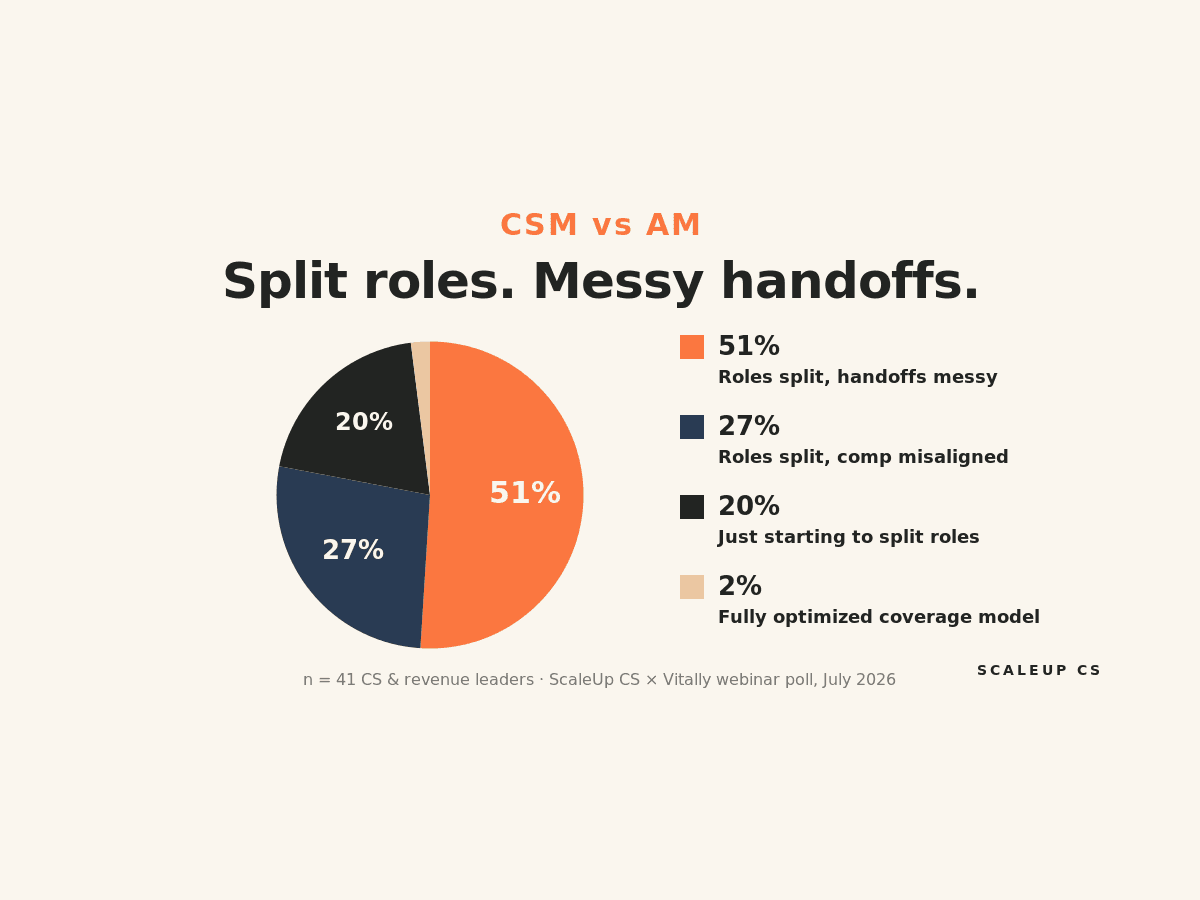
Last week, Linnea and I sat down with Vitally's Samantha Hunter and Hally Darnell to talk through building CSM and AM swimlanes without the two teams stepping on each other. We asked 41 CS and revenue leaders one question: where are you on your journey to defining clean CSM/AM roles? Here's what they told us:
51% said roles are separate, but handoffs are messy
27% said roles are separate, but comp structures are misaligned
20% said they're just starting to explore separating the roles at all
2% said they have a fully optimized, high leverage coverage model
Read that again. Three quarters of the leaders who answered have already done the hard part, splitting CSM from AM on paper, and they're still stuck. That's the real finding here. Separating the roles isn't the fix. It's the starting line.
The Messy Middle: 51% Have Split Roles but No Real Handoff
Just over half of the leaders who answered told us the same thing: CSM and AM are separate functions, but the handoff between them is a mess. I've built this split at companies from seed through Series C, and I've watched this exact failure mode play out more than once.
Here's what's usually underneath it. Teams draw the org chart, GRR to CSM, NRR to AM, and stop there. Nobody defines what happens the moment a customer moves from "CSM territory" to "AM territory." The CSM either sits on an expansion signal because it's not technically their job, or hands it off with a Slack message and zero context, and the AM starts the relationship from zero.
The framework Samantha and Hally walked through fixes this at the accountability layer, not the org chart layer. A RACI only works if you're precise about the middle two letters. Consulted has to mean input that actually changes the outcome, not a courtesy loop in. Informed means awareness, not veto power. Most of the friction between CS and AM teams comes from blurring those two.
The other fix matters just as much: make handoff triggers milestone based, not date based. An AM shouldn't inherit an account on day 90 because a spreadsheet says so. They should inherit it when the account crosses a defined threshold, seat count, usage signal, expansion readiness, and walk in with the full account history and a joint plan already built. That's the difference between a handoff and a demotion.
The Comp Trap: 27% Have Clean Lanes but Misaligned Incentives
More than a quarter of respondents told us their roles are separate, but the compensation underneath them isn't pulling in the same direction. This is the pattern I've run into the most at scaling companies, and it's a slower burn than messy handoffs because it looks fine from the outside. The org chart is clean. The dysfunction only shows up in the pipeline.
I've watched CSMs surface genuinely strong expansion opportunities, log them as CSQLs, and then watch them sit untouched because the AM's comp plan doesn't reward working a lead that isn't theirs. A weekly sync doesn't fix that. The comp plan does.
The model that actually holds up: comp CSQLs as a spiff, a flat dollar payout per qualified lead, not a hard quota. Hard quotas push CSMs toward volume, and quality drops fast once someone's chasing a number instead of a real signal. A tiered structure works well here: something like $100 for a smaller deal under $2K, $250 in the $2K to $5K range, and $1,000 or more once a closed deal clears $5K. Small enough that it doesn't turn your CSM into a sales rep in sheep's clothing. Real enough that surfacing a good lead is worth their time.
The other half of this is AM comp, and it's the piece RevOps teams skip most often. If an AM is paid on total expansion regardless of source, they have no reason to prioritize a CS sourced lead over one they found themselves. AM comp has to include CSQL follow through, tracked separately from their broader book, or CS sourced leads quietly die in the pipeline no matter how good they are. Worked CSQLs close at a 93% rate in the data we've seen. That's close to a guaranteed win sitting in the pipeline, and it still gets ignored if nobody's comped to touch it.
Still Exploring: 20% Haven't Split the Roles Yet
1 in 5 of the leaders who answered told us they're just starting to look at separating CSM from AM. If that's you, the timing question matters more than people think. One person wearing both hats is normal at seed or Series A. The AM function starts to earn its keep around $3M ARR, and by Series B, C, or D, or once you're managing 30,000-plus customers, a formal split stops being optional.
Size isn't the only variable though. Renewal complexity matters just as much. A simple, low touch renewal cycle can run on one role well past $3M ARR. A complex, multi stakeholder motion can outgrow a single owner much earlier. Don't split the roles because a revenue number told you to. Split them when one person can no longer hold both the trust relationship and the commercial motion without dropping one.
The Rare 2%: What a Fully Optimized Model Actually Looks Like
Only one person, out of the 41 who answered, said their coverage model is fully optimized. I don't think that number is depressing. I think it's honest. Nobody nails CSM vs AM swimlanes on the first attempt, and the teams furthest along got there through iteration, not a single reorg.
The pattern I've seen work: treat the split as a 90 day build, not a one time announcement. Audit every customer touchpoint first and get down to two or three real contacts per account, CSM, AM, support. Define the handoff structure in writing before you touch comp. Align the incentives once the structure is solid. Then pilot with a subset of accounts, take feedback, and scale it. Skip the audit step and you're rebuilding the whole thing in six months.
Where This Leaves You
If you're in the 51%, your roles are fine. Your handoff triggers and your RACI clarity aren't. Fix the accountability layer before you touch anything else.
If you're in the 27%, your org chart is fine. Your comp plan is fighting itself. Look at CSQL structure first.
If you're in the 20%, don't anchor the decision to an ARR number alone. Anchor it to renewal complexity and how much your CSMs are already dropping.
And if you're the one respondent who said your model is fully optimized: I'd genuinely like to know what got you there.
We covered the full framework, including the RACI breakdown and the complete CSQL comp model, in the live session with Vitally. Watch the full webinar replay here.