AI & Automation in CS
CS Leadership & Team BuildingAI & Automation in CS
Will AI Replace CSMs? Only the Ones Who Were Never Actually Doing the Job.
September 21, 2026·4 min read
Every CSM asking whether AI will replace them is asking the wrong question. The job was never reports, decks, and check in emails, that was scaffolding bolted onto a role that was always about two things: teaching customers to run their own business better, and owning the commercial conversation that proves it. This piece breaks down what AI is actually good at automating, what it can't touch, and what CSMs (and the leaders who hire them) need to do differently now.
Every CSM I talk to right now has some version of the same knot in their stomach. They've seen the demo. They've read the headline. And somewhere between the exec team's AI roadmap slide and their own performance review, they've started wondering if there's a version of this job that doesn't need them anymore.
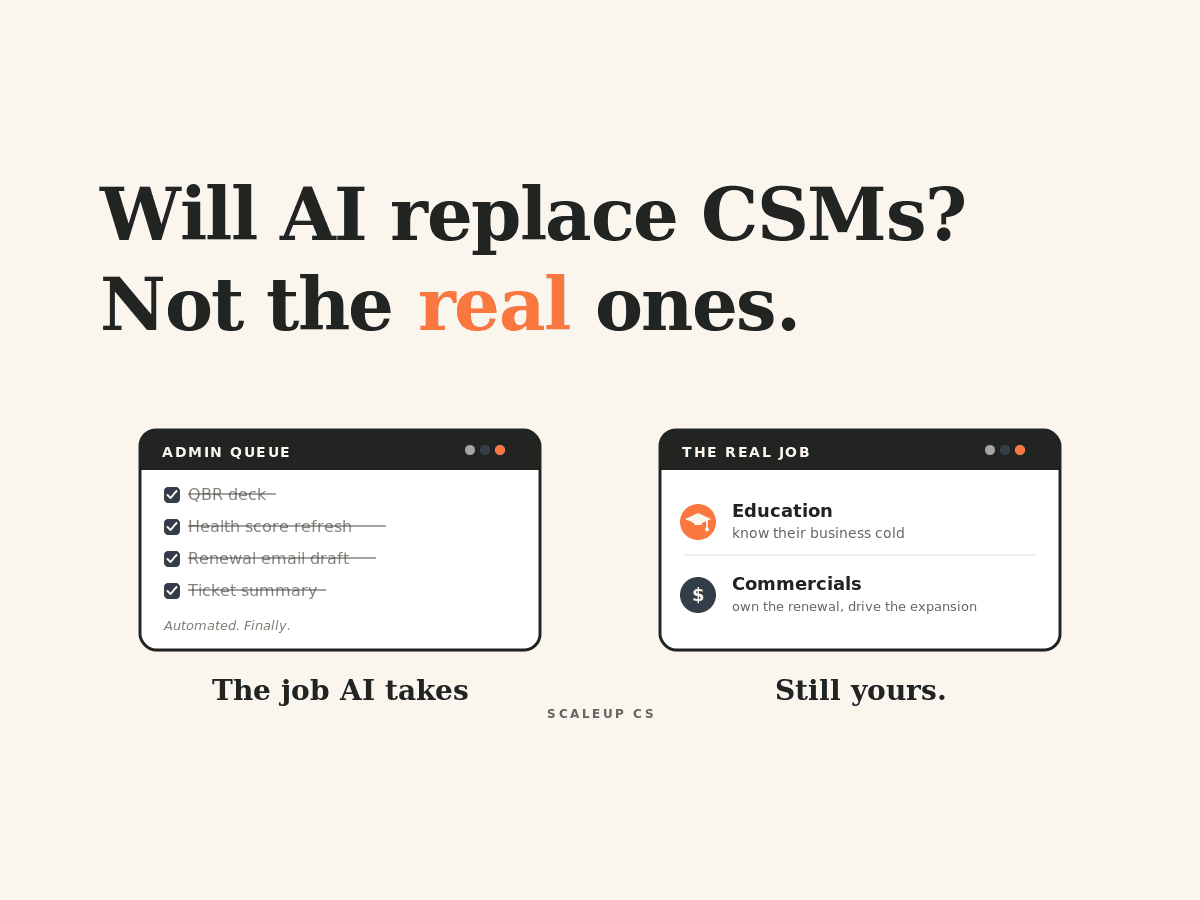
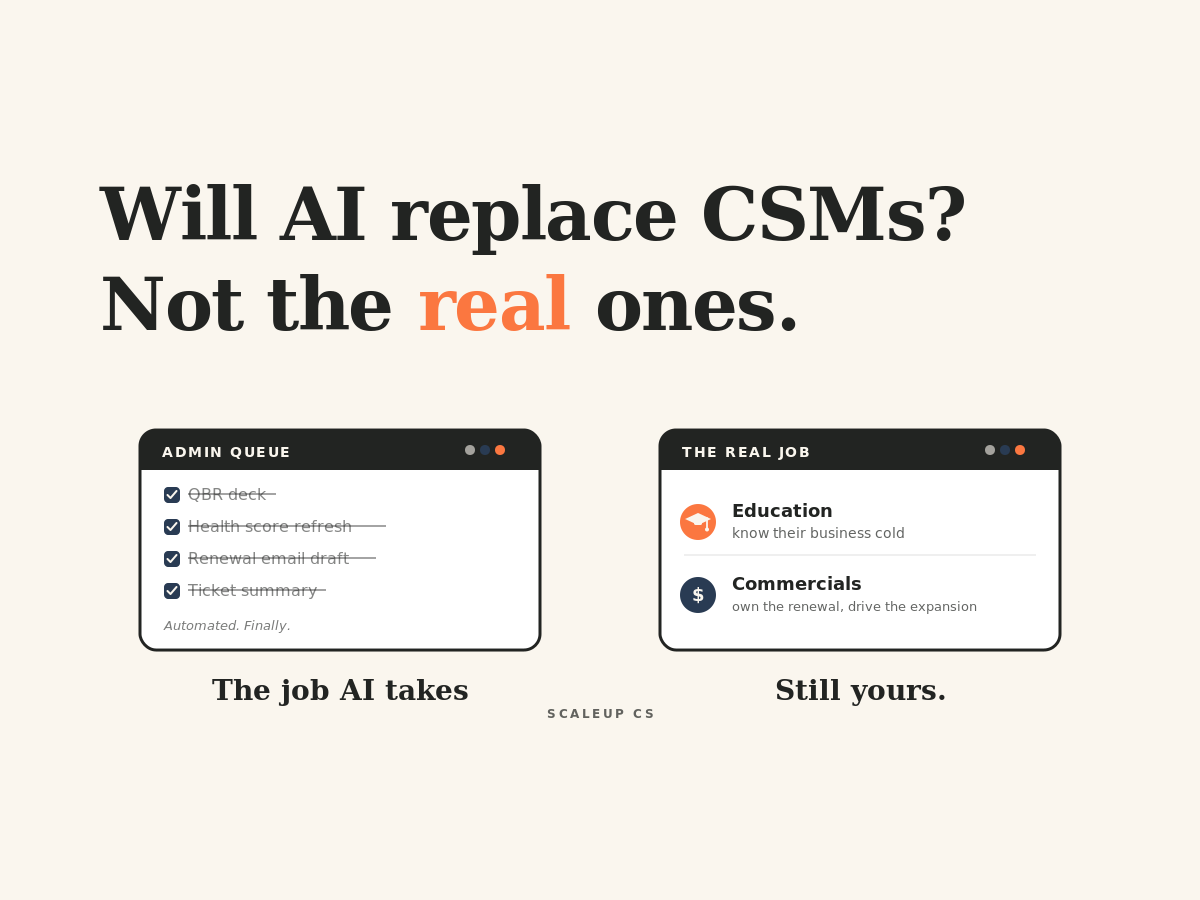
Here's my honest answer: if all you're doing is decks, emails, and dashboards, then yes, that job is going away, and it was never the real job to begin with. The CSM role has only ever been about two things: education and commercials. Everything else, the reporting, the check in cadences, the CRM hygiene, was scaffolding that got bolted onto the role because nobody else wanted it. AI is very good at scaffolding. It should take it, and it's overdue.
The job is education, not decks
I wrote about this a while back when I talked about why I'd rather hire an industry expert than a CS resume. The point still holds, and AI makes it sharper: education is not teaching your user which button to push on the platform. It's teaching them to do their own job better using your platform.
That means you need to know how your customer operates. You need to understand their pain point better than they understand it themselves. Your product is just the mechanism you hand them to relieve that pain, it was never the point of the conversation. A CSM who can only walk someone through a feature is running a help desk with a nicer title. A CSM who can sit down with a VP of Ops and teach them something about their own business they didn't already know, using your product as the proof, is doing the actual job, and no model I've tested can do that unsupervised.
The job is commercials, not admin
The other half is commercials, and CS leaders love to soften this into "relationship management" because it sounds nicer. It isn't softer. Owning the renewal conversation, the expansion pitch, the pricing pushback, all of that is commercial work, and it requires the same instincts a good AE has, pointed at retention instead of acquisition. A CSM who can't hold their own in that conversation isn't protecting revenue, they're hoping the contract renews itself.
Education and commercials aren't two separate skills bolted together, they're the same skill pointed in two directions. You teach a customer to get more value out of the product, and that value is exactly what justifies the renewal, the expansion, and the next pricing conversation. Cut either half out and you don't have a CSM, you have an admin with a quota attached.
Say it plainly
I didn't get into customer success to write reports, build decks, and monitor stats like a robot. I love this job because I get to work with people and teach them something that makes their day to day better. If you got into this job for the admin, or you've been coasting on the fact that the job was mostly admin, you were never actually doing customer success. You were doing operations with a CS title on it, and AI is about to make that very hard to hide.
That's not a gentle statement, and I'm not going to soften it. This is a good thing for the CSMs who actually do the work. The busywork that used to bury education and commercials under 20 hours a week of admin is finally getting automated out from under them, which means the people who were always doing the real job are about to look a lot better than they already did.
What I'd actually do about it
If you're a CS leader, the hiring side of this argument isn't new for me, I made the full case for it in I'd rather hire an industry expert than a CS resume. Go read that one. Short version: stop hiring and promoting for CS pedigree, and start hiring for whether someone can learn a customer's business well enough to teach them something about it.
If you're a CSM, here's the part that actually matters for you day to day. We've been saying "learn your customer's business" for years, and it somehow always slides back into learning your own product instead, because that's the easier, more comfortable target. Go the other way. Learn their business. Learn their challenges and their pitfalls. Ask where they're having trouble renewing their own customers. Ask where their customers get stuck. Dig for that intel the way you'd dig for objections in a renewal conversation, and don't stop until you actually understand their problems in full. Only then map how your platform addresses what you found. Their problem first, your product second. That's how you stay useful, and it's how you stay employed.
That's the exact conversation we're walking through in more depth today. We're calling it the CSM role rewrite, because "will AI take my job" is the wrong frame. The better frame is: what does competence look like now that the admin half of the old job description just got automated. Join today's session here.
Bottom line
AI isn't replacing CSMs. It's replacing the admin that got mistaken for the job. If you were ever actually doing education and commercials, that isn't going anywhere, it's finally getting the hours it deserved. If admin was the whole job for you, that was already a problem before AI showed up. It's just impossible to hide now.