CS Leadership & Team Building
Sales–CS AlignmentCS Leadership & Team Building
CSM vs. AM Swimlanes: How to Define Renewals and Expansion Ownership in 2026
June 23, 2026·7 min read
 Nina Wilkinson
There's an ongoing debate about whether CSMs should own commercial quota. The answer is more nuanced than yes or no. Here's how to structure clear swimlanes between Customer Success and Account Management, keeping CSMs focused on GRR and retention while giving AMs the tools to drive NRR, and the CSQL compensation model that keeps both teams aligned.
The question lands in my inbox more than almost any other right now: "Should my CSMs own expansion quota?"
I get it. You've got AEs closing deals, a CS team onboarding customers, and at some point someone in a leadership meeting says, "CSMs are already talking to these customers every week. Why aren't they closing the upsells too?" It sounds efficient. It sounds aligned. It's also one of the fastest ways to break the thing that makes your CS team worth having.
I've built and restructured post sales teams at companies from seed stage through Series C. Here is what I've learned: the debate over CSM vs AM swimlanes isn't really about quota. It's about trust, and what happens to your revenue retention when you put the wrong incentive on the wrong person. Let me walk you through the model I've actually deployed, including the compensation structure that makes it stick.
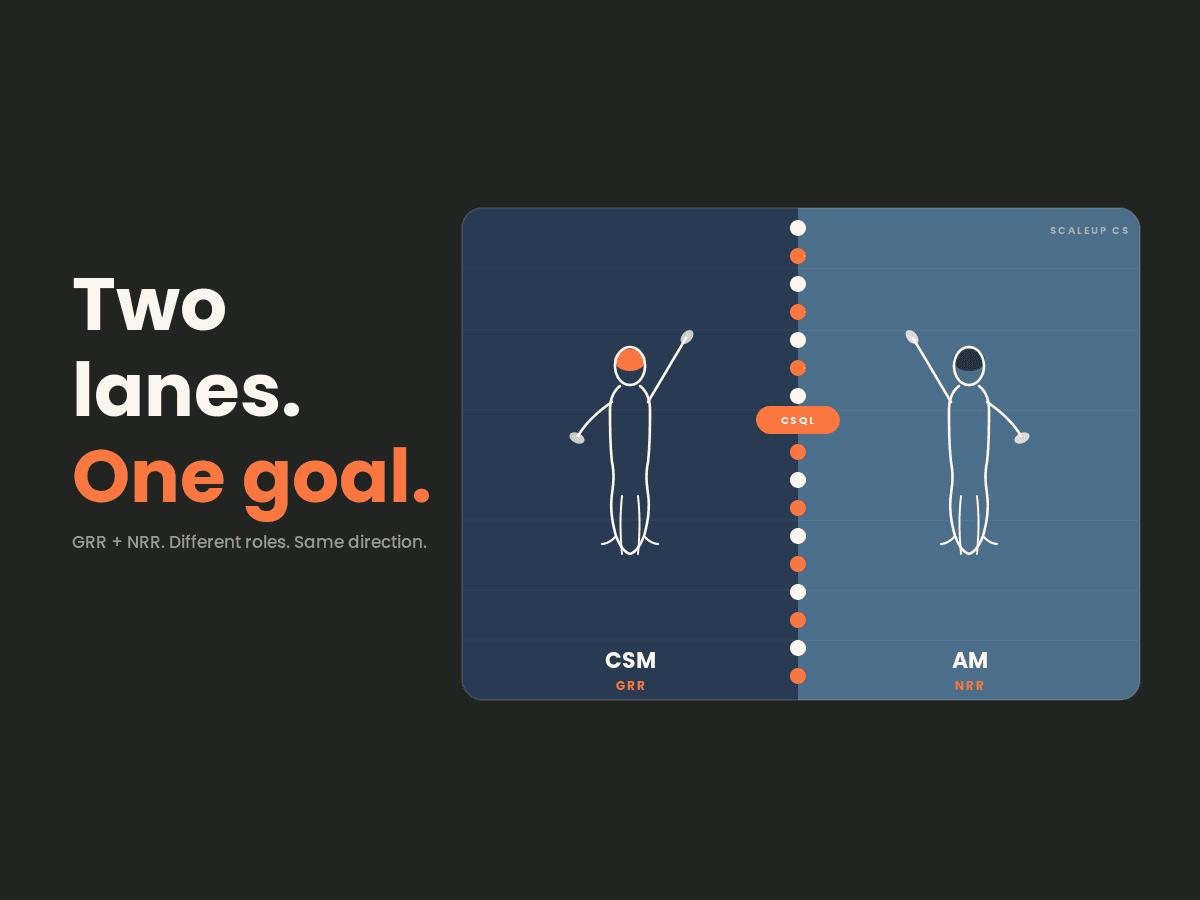
The Modern Post-Sale Split (GRR vs. NRR Ownership)
Before you can design the right org model, you need clarity on what you're optimizing for. Gross Revenue Retention and Net Revenue Retention are not the same goal, and treating them that way is where most early-stage founders get into trouble.
GRR measures how much of your existing revenue you keep, churn and contraction only. NRR adds expansion back in. A company with strong GRR but weak NRR is retaining customers but not growing them. A company with high NRR but deteriorating GRR is papering over churn with upsells, which is a much more dangerous position than the numbers suggest.
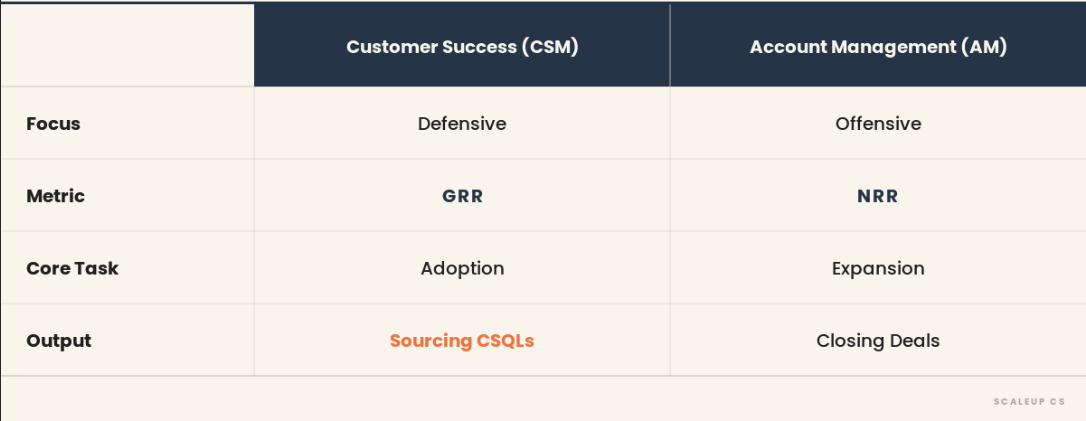
The swimlane model assigns ownership of these two metrics to the people best positioned to move them.
The Defensive Guard: Why CSMs Must Own Gross Revenue Retention
Your CSM's primary job is to protect the base. That means TTV, adoption, health monitoring, and getting ahead of renewal risk before it becomes a conversation your AE has to rescue. When a CSM is focused on GRR, they're in the room during implementation, they're tracking usage data before it trends the wrong direction, and they're the person the customer calls when something is not working.
That relationship only works if the customer trusts that the CSM has their back. Customers can smell the commission breath a mile away. The check-in call that used to feel like someone looking out for them starts to feel like a run-up to a pitch. And once that trust erodes, you are not just losing the expansion opportunity. You are putting the renewal itself at risk.
CSMs who own GRR are health guardians. That is the frame I use with every team I build. Not relationship managers. Not glorified support reps. Health guardians who understand the commercial landscape well enough to protect the customer's investment and flag risk early.
The Offensive Engine: Why AMs Drive Net Revenue Retention
Account Managers or dedicated growth reps own the expansion and cross-sell motion. They're the ones building the commercial relationship, mapping stakeholders, and driving the conversations that turn a happy customer into a larger one.
This is not a demotion of the CSM role. It's a specialization. The AM brings the commercial expertise. The CSM brings the ground-level trust and product knowledge. When these two functions work in tandem, with clear lanes and complementary goals, you get an expansion motion that feels natural to the customer rather than predatory.
The companies I've seen win at NRR are almost never the ones where CSMs are carrying full quotas. They're the ones where CS and AM are genuinely coordinated, with a handoff process that is structured and an incentive model that rewards collaboration.
Reclaiming Bandwidth: How AI Redefines the CSM Skill Profile
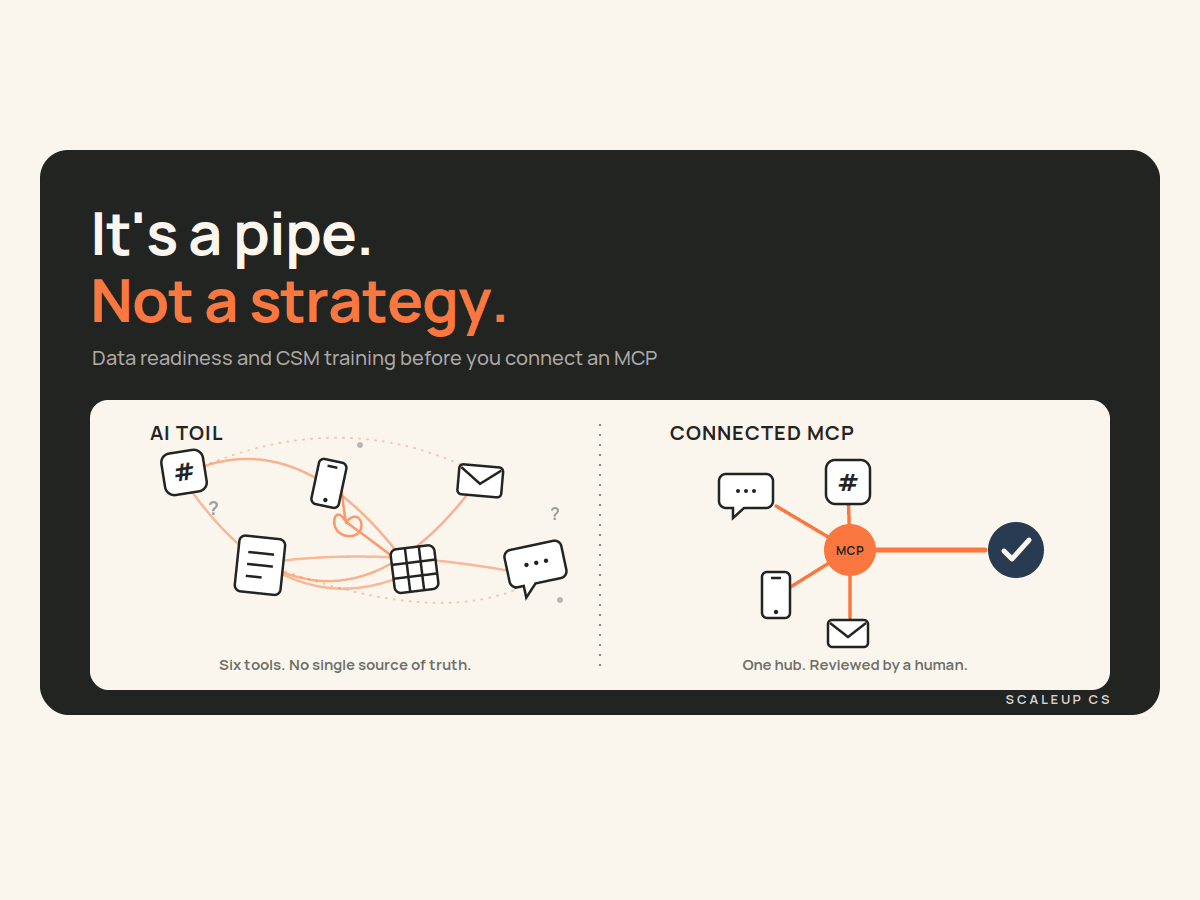
Here is where this conversation shifts for 2026. AI is compressing the admin work that used to fill a CSM's week. QBR prep, health score logging, renewal tracking, at-risk flagging. Tools that used to take hours are taking minutes. That creates capacity. The question is what you do with that capacity.
When you intentionally embed AI workflows to automate routine admin tasks (like auto-generating executive briefs, auto-logging CRM fields, and restructuring account notes), you reclaim 5 to 10 hours per CSM, every single week. If you're wondering how to incorporate AI into your team's workflows, we shared what we're building here.
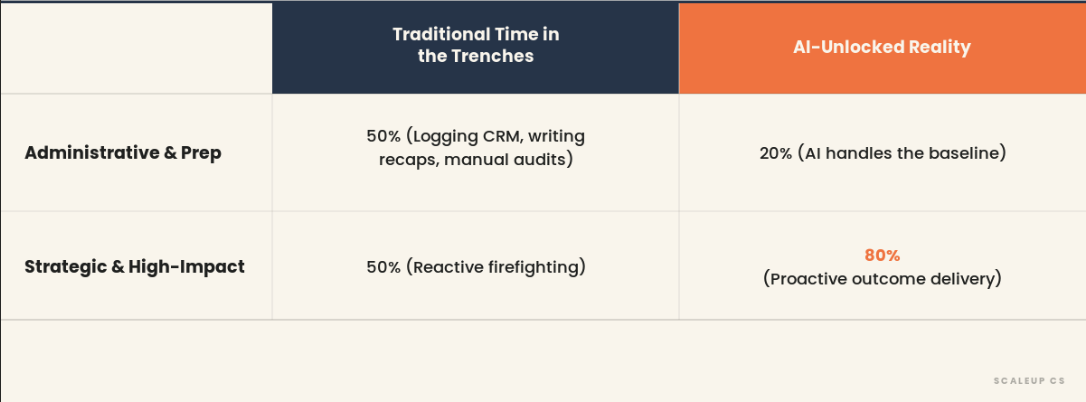
The answer is not "more accounts per CSM" (though that will happen too). The answer is commercial fluency.
Moving Beyond Admin: Building Commercial Fluency into Post-Sale Teams
Commercial fluency is not the same as owning a quota. It means your CSM can sit across from a CFO and have a grounded conversation about where the customer is in their contract cycle, what the ROI story looks like for renewal season, and what a larger investment would actually unlock for their business. It means they are not flinching when pricing comes up. It means they can hold their ground in a soft negotiation anchored in long-term value.
I've built this into CS teams by changing the profile we hire for and by adding commercial training to new employee onboarding. You need to add mock calls here to support this as well. The CSMs who thrive in the next few years are the ones who understand the business context around their accounts, not just the product usage data. That is a different hire than most early-stage founders are making right now.
The 3 Pillars of a Commercially Minded CSM: Data, Pricing, and Strategy
The framework I use with clients has three components:
Data fluency. The CSM should be able to tell the customer's ROI story before the AM ever enters the room. Usage data, adoption benchmarks, business outcomes tied to the product. This is the credibility layer.
Pricing literacy. Not memorizing every SKU and discount tier, but understanding how the product is packaged, what expansion looks like financially, and being comfortable when a customer asks "what would it cost to add X?" without immediately deflecting to the AE or AM.
Account strategy. Understanding where the customer is going as a business, who the internal champions are, and where the whitespace for expansion actually lives. CSMs who think strategically about their accounts surface better CSQLs and create better handoffs.
This is not turning CSMs into sales reps in sheep's clothing. It's making them better trusted advisors who understand the full commercial picture.
The CSQL Playbook: Hyper-Aligning CSM and AM Compensation
This is where the rubber meets the road, and it's exactly where most scaling companies trip up.
At prior companies, I watched a painful pattern repeat. CSMs would uncover incredible expansion opportunities and log them as Customer Success Qualified Leads (CSQLs) in Salesforce, but nothing happened. The AMs, focused entirely on their own massive standalone expansion targets, let those warm handoffs gather dust. We literally had to implement mandatory weekly leadership syncs just to ensure leads were not being dropped.
You cannot fix a structural alignment problem with an administrative meeting. You have to fix it with complementary compensation.
The CSM Incentive: Rewarding Closed-Won CSQL Volume
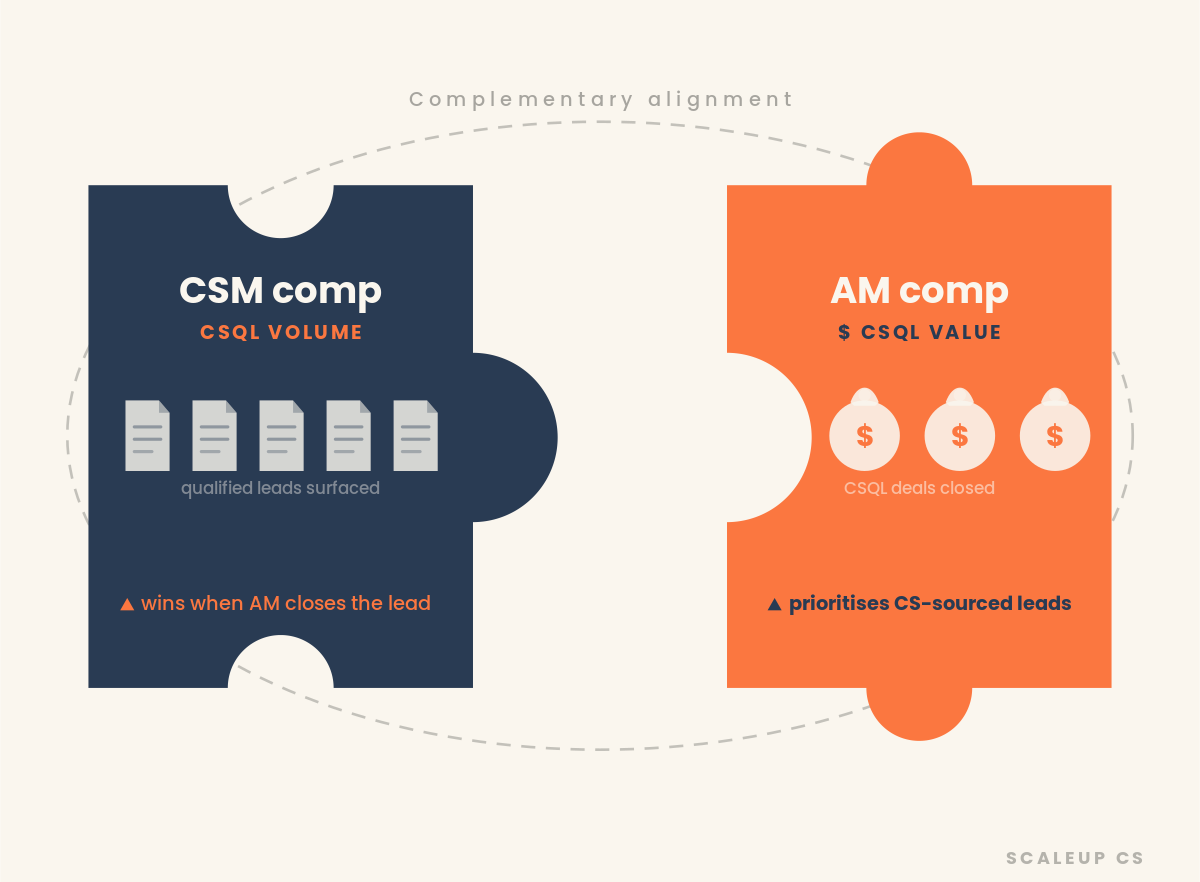
Comp your CSMs on closed-won CSQLs. Not on expansion dollars. Not on renewal rate alone. On the volume of qualified expansion opportunities they surface that the AM actually closes.
This matters for two reasons. First, it gives CSMs skin in the game on growth without making them responsible for closing. Second, it creates a quality filter. A CSM who gets paid on closed-won CSQLs has every reason to hand AM real opportunities, not noise. If AM is closing them, the signal was right. If they keep dying in the pipeline, the CSM has to look at whether they are qualifying correctly.
I've run this model with early-stage teams and the behavioral shift is real. CSMs start thinking about their accounts differently. They're not just monitoring health. They're pattern-matching for growth signals.
The AM Incentive: Driving Accountability through Shared CSQL Dollar Value
Comp your AMs on the dollar value of CSQLs closed, tracked separately from their total expansion book. This is the piece most RevOps teams skip, and it's where the alignment breaks down.
When an AM is paid on total expansion regardless of source, they have no reason to prioritize CS-sourced opportunities over ones they generated themselves. They might work them. They might not. There is no accountability mechanism.
Tying a portion of AM comp to CSQL-sourced revenue creates that accountability. Now the AM has a reason to close what the CSM brings them quickly and well, because it moves their number. And the CSM has a reason to bring them real opportunities, because their number only moves on closed-won.
This is the complementary alignment model. Both functions have skin in the same outcome. Different roles, different parts of the equation, one shared result.
Building It in Your Org
If you are under $50M ARR and your CSMs are carrying full commercial quota right now, I would start here: separate the roles in your org chart before you touch comp. Make it explicit, in writing, that GRR is the CSM's primary metric and that expansion pipeline lives with AM. Then build the handoff process and define what qualifies as a CSQL. Only once that infrastructure exists does the comp model work the way it should.
The other piece that gets skipped: deliberately investing in the relationship between your AM and CS teams. I've seen the structural alignment fall apart not because the comp model was wrong, but because nobody built genuine trust between the two functions. Joint account reviews, shared Slack channels, and regular pipeline syncs are not nice-to-haves. They are the connective tissue that makes the whole model function. If AM and CSM teams are operating in separate silos and only talking when a CSQL gets created, the handoff breaks down. Start with shared goals, not just shared tools.
You will not get this right on the first draft. I have not seen a company yet that nailed CSM vs AM swimlanes on the first try. What matters is that you start with the right structural principle: protect the trusted advisor relationship, then build the commercial motion around it.
If you are working through what this looks like for your specific team size, stage, or motion, I am happy to walk through it together. Book a time here.