AI & Automation in CS
Everyone's Being Told to Use More AI. Nobody's Asking What It Costs or Where the Data Goes.
 Nina Wilkinson
 Nina Wilkinson
Every CS platform now promises an AI health score that catches churn before it happens. But if 8% of your customers churn, a model that predicts nobody will churn is 92% accurate and completely useless. This piece covers what AI scoring actually changes, where it fails (bad data, too few churn events, enterprise blind spots), and how to prove a model works in 2 quarters instead of 2 years.
Every CS platform pitch right now includes some version of the same promise: our AI-powered health score will catch churn before it happens. Predictive risk indicators, automated alerts, a model that sees what your team can't.
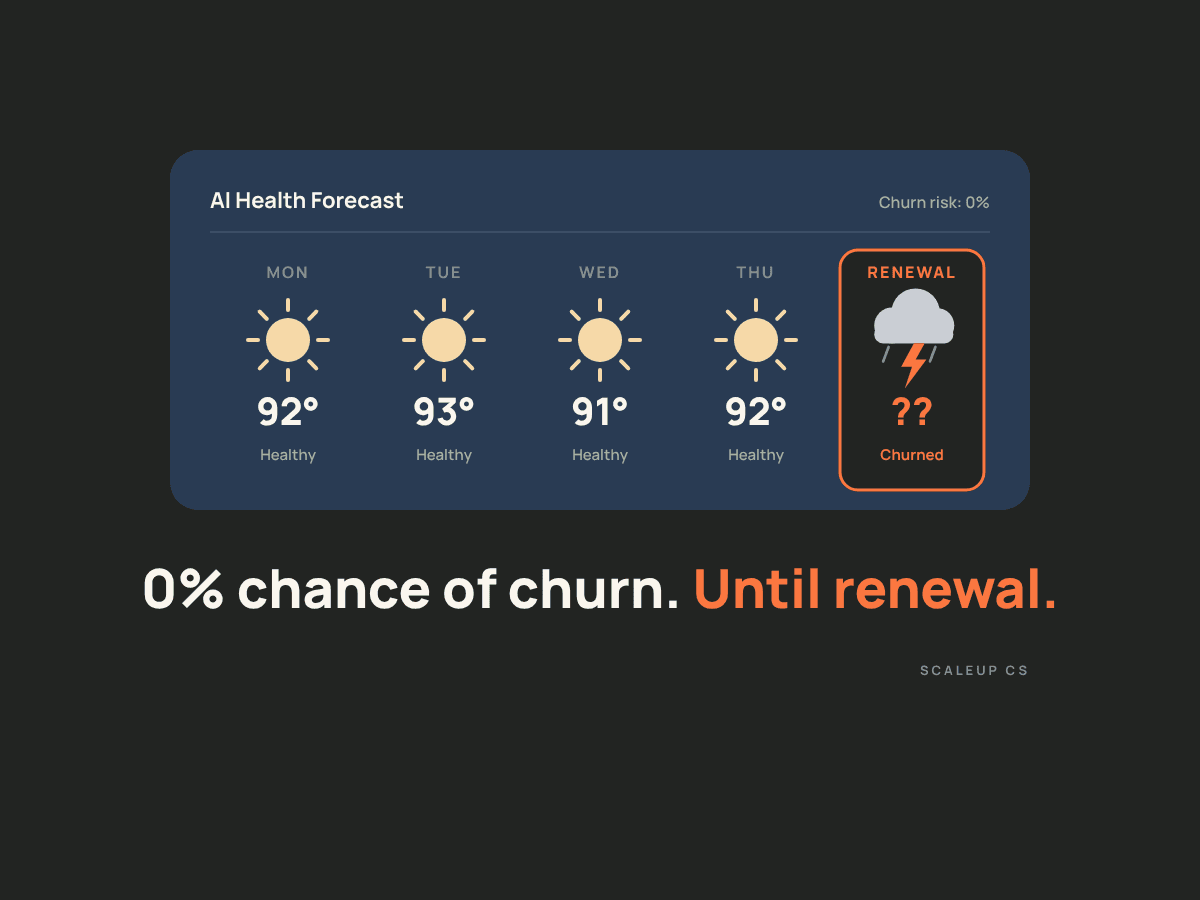
And yet, the churn keeps showing up "out of nowhere." The account was green last month. The renewal call was on the calendar. Then the customer told you they're consolidating vendors.
CS leaders already know something's off. In our recent webinar poll, 77% of CS leaders said the health score isn't dead, but theirs needs a rebuild. Only 12% said theirs works well.
So does AI fix that? Before you answer, here's a quick gut check on how these tools get sold. Vendors love to lead with accuracy. But if 8% of your customers churn each year, a model that predicts "nobody churns" is 92% accurate. It's also completely useless. Accuracy is the wrong question to ask.
The useful question isn't "is AI smarter?" It's "does this score catch at-risk accounts early enough, often enough, and clearly enough that a CSM can act?"
My take: AI-driven health scores can outperform traditional rule-based scoring, but only if they model the right contextual signals instead of just aggregating raw telemetry faster.
Most health scores still look something like this: login frequency 30%, feature usage 30%, CSM sentiment 40%. Somebody picked those weights a few years ago, and nobody remembers why.
The flaw is structural. Fixed weights are rigid, they lag behind what the customer actually intends to do, and they lean on human bias and arbitrary thresholds. That's why so many scores stay green right up until the renewal call. (We went deep on this in The Death of Vanity Metrics, so I won't rehash it here.)
Our poll backs this up. 69% of teams run their health scores on mostly activity metrics, or a mix with only some outcome metrics layered in. Only 8% are mostly outcome-based.
AI scoring flips the approach. Instead of humans guessing the weights, the model analyzes pattern changes across much more data: support tickets, product adoption velocity, executive sponsor movement, email and call sentiment.
The real upgrade is that it picks up signals humans miss:
Gradual usage decay that never crosses a threshold but trends down for months
Stakeholder changes, like a champion going quiet or a new name showing up on every thread
Shifts in how the product gets used, like usage holding steady while the type of feature being used changes abruptly (a team that stops building new workflows and only exports data is telling you something)
Where AI truly wins: large books of business, lots of unstructured data, and low-touch segments where no CSM is watching closely enough to notice any of this.
Here's where I'd push back on the hype.
The garbage in, garbage out trap. If your product data or CRM hygiene is poor, AI just reaches the wrong conclusions faster. The biggest gap we see is upstream: 40% of teams rarely or never capture the customer's target business metric at handoff, and only 16% do it for every account. If nobody defined the outcome the customer bought, no model can predict whether they're reaching it. (This is exactly why we recommend building a CS Data Dictionary before you buy anything.)
Not enough churn events. AI models learn from outcomes. A company with 150 customers and 12 churns a year doesn't have enough of them to train on. The model is pattern-matching on noise, and it'll sound confident doing it.
A false sense of security. When the score becomes the job, CS teams get passive. They manage to the metric instead of doing real discovery. A green dot is not a conversation with the economic buyer.
The blind spot of enterprise complexity. AI handles transactional, low-touch churn well. Complex B2B churn is a different animal. It's often driven by offline changes like reorgs, budget cuts, and executive shifts that never show up in product telemetry. Your model can't see the board meeting where your line item got cut.
AI churn prediction isn't magic. It's mechanics. Here's the playbook we're using with our clients.
Usage data tells you what customers are doing. It doesn't tell you who's paying attention or why. Feed the model unstructured data alongside product usage: email threads, meeting transcripts, executive sponsor activity. The signals that predict enterprise churn usually live in conversations, not dashboards.
A green, yellow, or red label hides the thing that matters most: direction and speed. Focus on velocity of change instead. A 20% drop in core workflow completion over 14 days is a signal a CSM can investigate. A score that slid from 74 to 68 is not.
The standard advice is to run a new model alongside your old one for a couple of renewal cycles. Most scaling teams don't have that kind of time. Here's how to get a real answer in about 2 quarters:
Backtest first. Run the AI model against the accounts that churned or downgraded over the last 12 to 18 months. Did it flag them? How far ahead? This takes weeks, not renewal cycles, and it'll tell you quickly whether the model sees anything your current score missed.
Then shadow it for a quarter. Run AI scoring alongside your existing score and measure both against leading risk events, not just renewals: downgrades, champion departures, escalations, and accounts going dark. You'll get far more data points in 90 days than waiting on renewals ever gives you.
Judge on 2 things. Which score flagged the risk first, and could the CSM tell why? A flag nobody can explain is a flag nobody acts on.
A prediction without a play just tells you sooner that you're going to lose. Every AI flag should trigger an immediate human investigation with a named owner and a defined next step, not a quiet update to a dashboard nobody opens.
AI isn't a magic wand for retention. But when it's fed rich, multidimensional data and paired with real playbooks, it's a major upgrade over static scoring.
So stop asking "What is our account health score?" Start asking "What specific change in customer behavior is this model flagging, and why?"
I'm curious where your team has landed. Are AI health scores actually working for you, or are they just generating noise? Reply or drop a comment. I'd love to hear what you're seeing in the trenches.