CS Operations
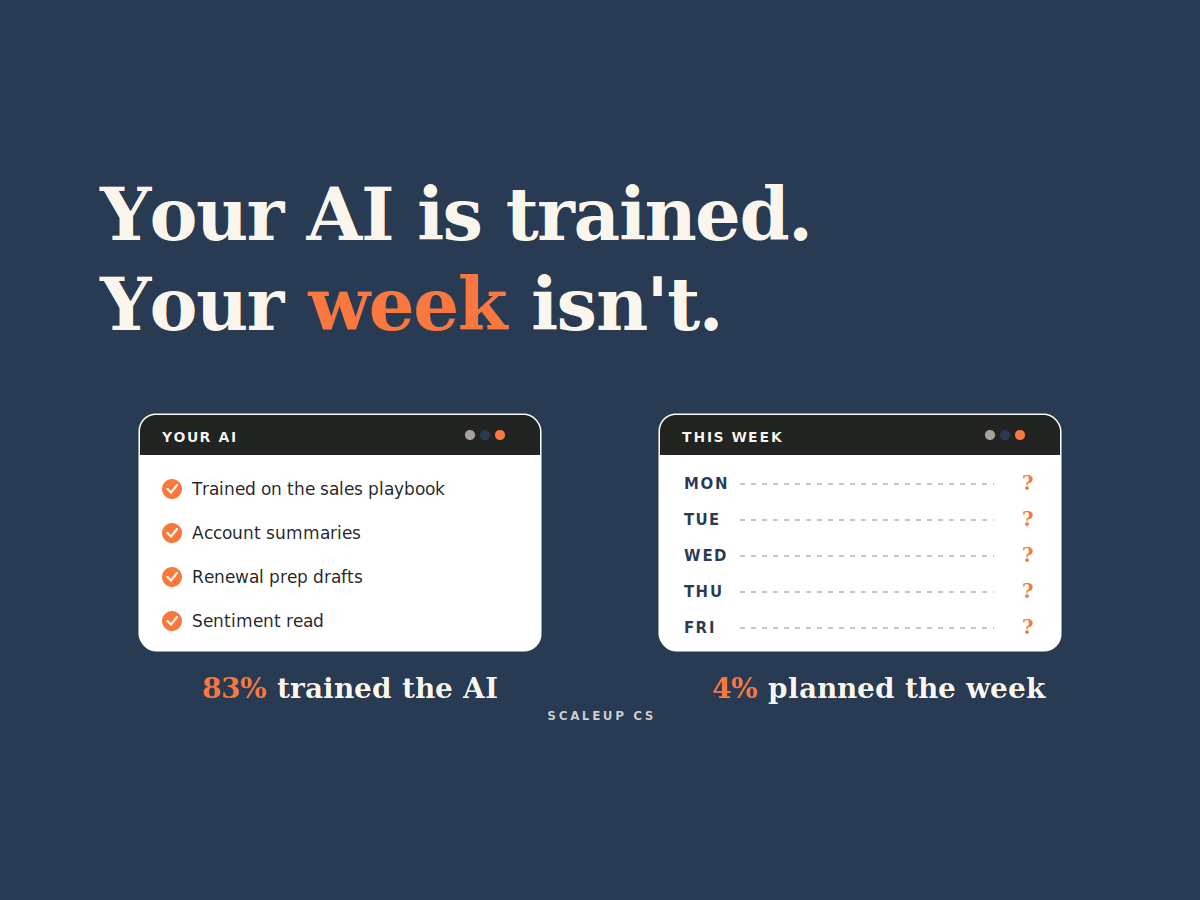
Your Team Trained the AI. Nobody Trained the Week.
 Nina Wilkinson
 Nina Wilkinson
We spent a day at CS Week's Moment conference in NYC, and one theme kept coming up: nobody has a fully fleshed out AI plan for customer success yet. This piece covers where the biggest AI win really is for CS teams, why building your own CSP is a long-term ownership problem (and what Vanta's in-house build gets right), and the three things CSMs need to become as the role changes.
Last week we spent a day in New York at Moment, CS Week's conference for post sales leaders. Four stages, 50+ speakers, and a session track that was worth the trip on its own. I went in expecting to hear how the most AI-forward CS teams have it all figured out. I came out with something more useful: nobody has it figured out yet, including some of the teams on stage. And you know what, that's ok.
Here are the three things I kept hearing, and where I land on each.
Across nine sessions, the real version of almost every AI story was some form of "we tried a lot of things and a few of them stuck."
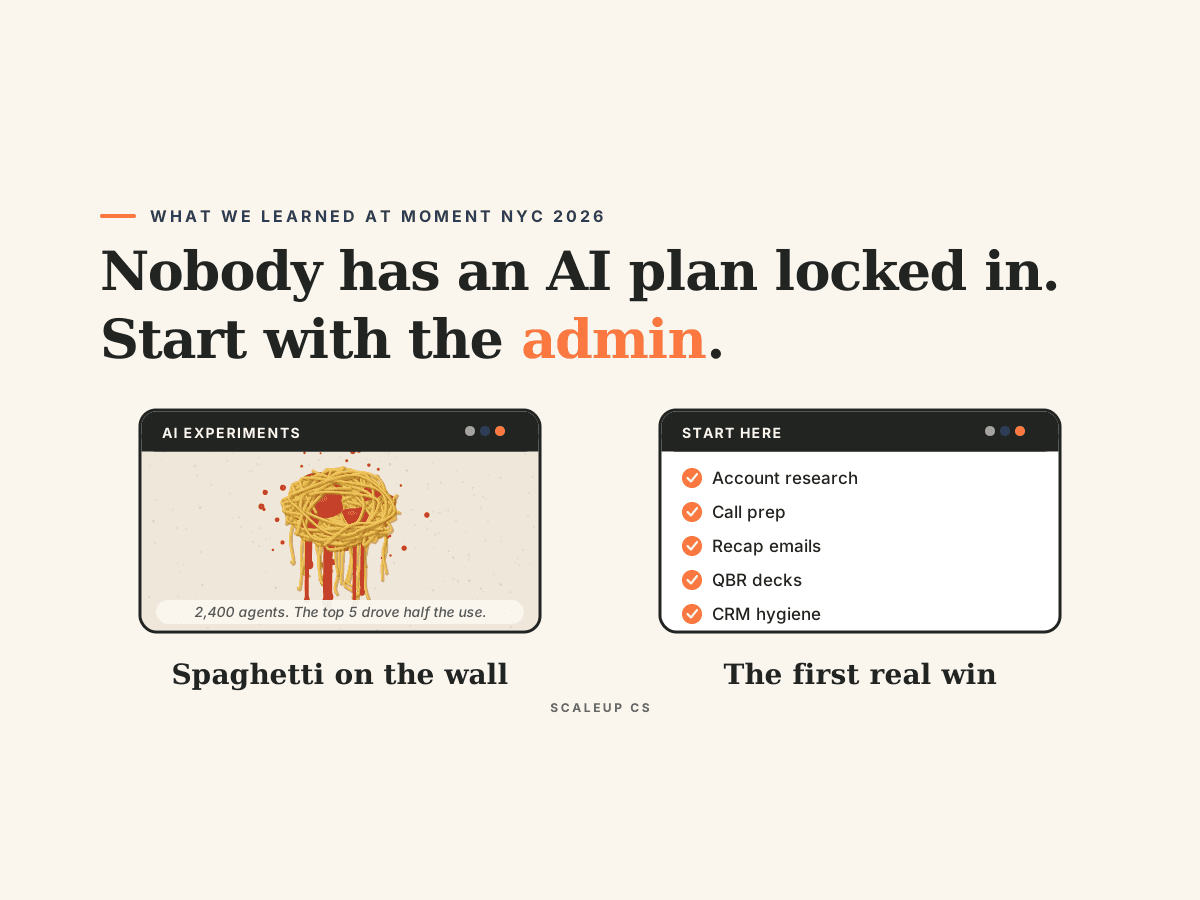
One team described its first phase as "let a thousand flowers bloom." More than 600 builders across go to market produced roughly 2,400 agents. The top five captured about half of all the activity. The rest ran into fragile prompts, no QA, no shared ownership, and time savings that stayed trapped with whoever built them.
Another panel admitted they opened AI build access to the whole org too early, watched agents multiply with no quality control, and had to rein it in with an AI committee. Several speakers said the same thing about buying: they got excited by a demo and bought a tool before they'd defined the problem it was supposed to solve.
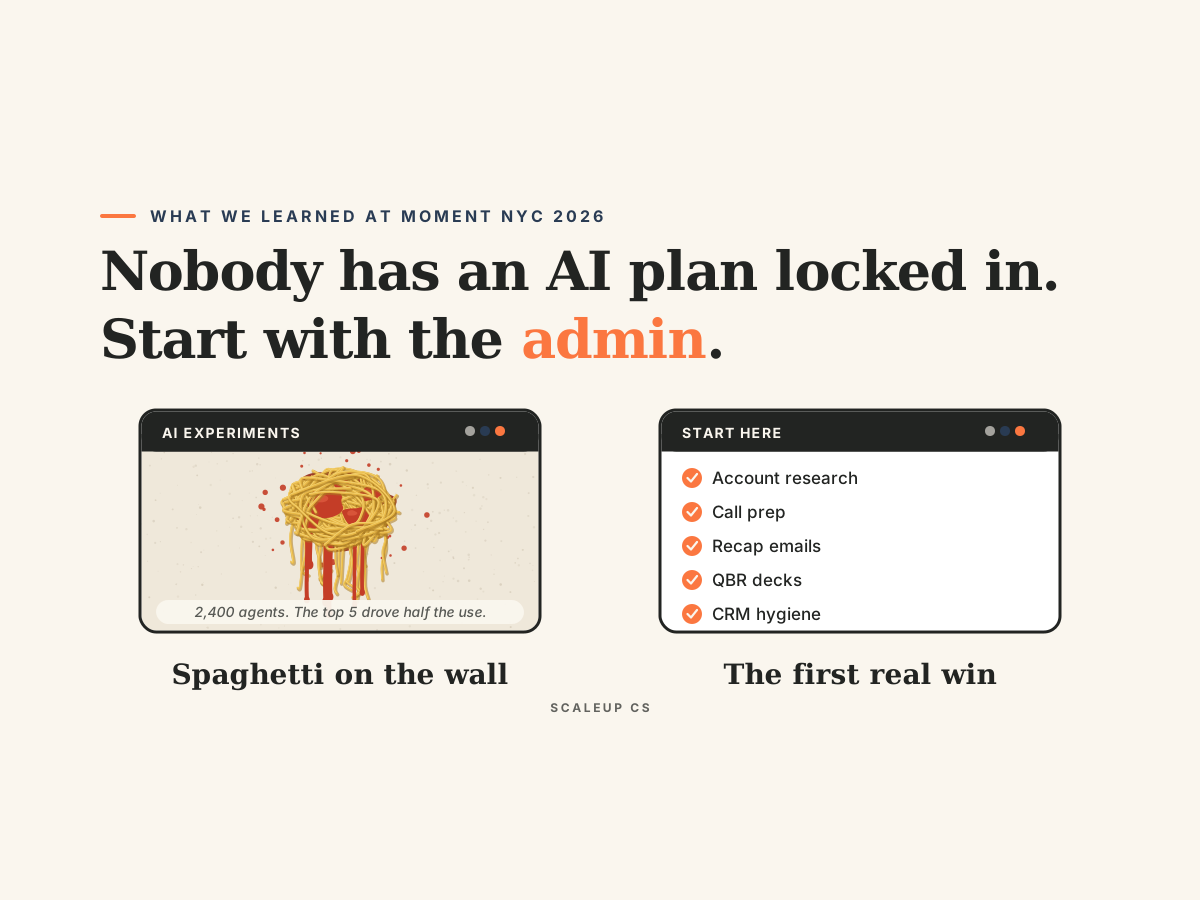
That's spaghetti against the wall. And to be fair, some of it should be. Testing different paths for different team types makes sense. A scaled, digital-led motion won't use AI the same way a white glove enterprise book does. One panelist drew that line clearly: premium customers expect a human on the phone with AI supporting them, while lower price point customers can lean much harder on AI, with human touchpoints saved for the moments that matter.
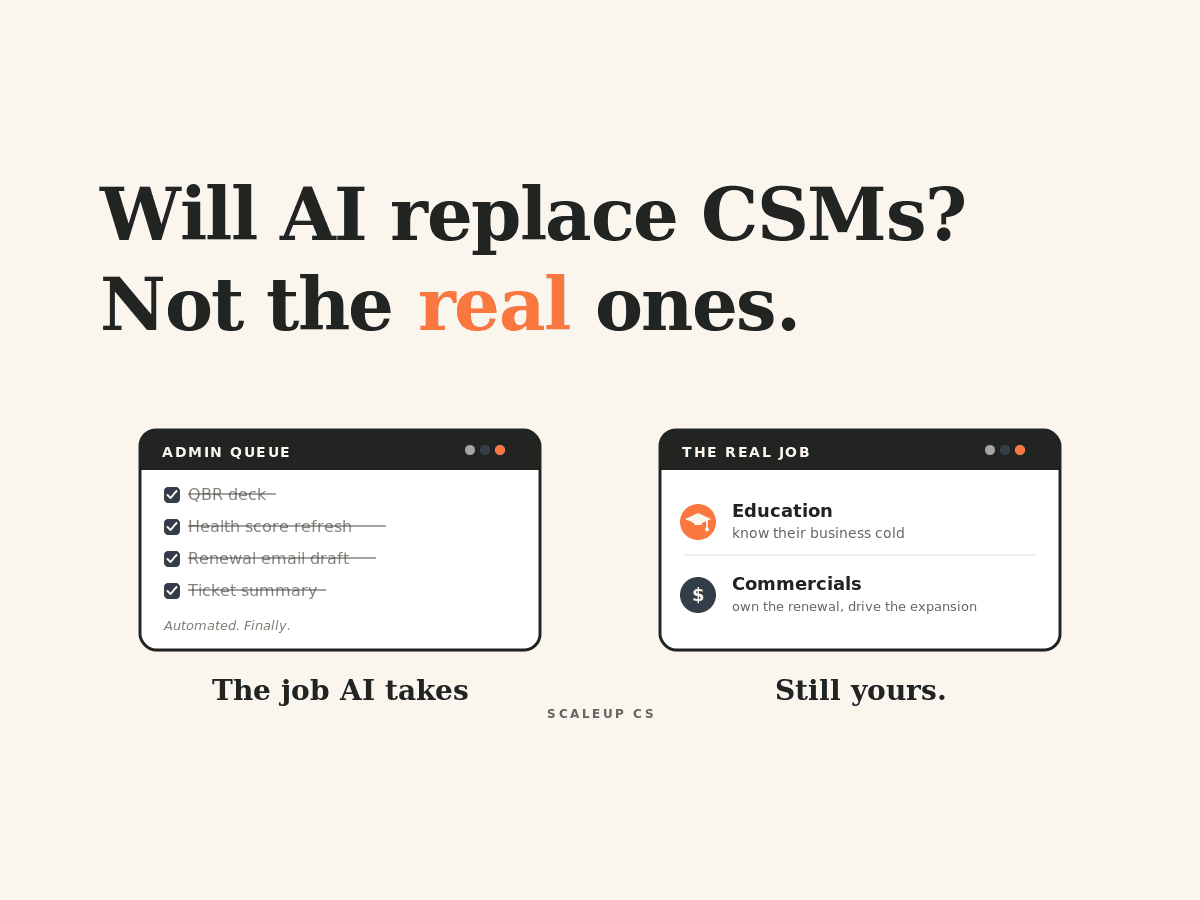
But here's my take. The biggest win isn't hiding in agent number 2,400. It's the one Linnea and I walked through in last month's webinar on the CSM role rewrite, and in Will AI Replace CSMs?: take the admin off your CSMs' plates, then reinvest that time into education and customer knowledge.
Account research, call prep, recap emails, QBR decks, CRM hygiene. That's the scaffolding. Automate it first. It's the lowest risk place to start, and every CSM on the team feels the difference in week one.
One speaker said the next part better than I could: adding more accounts to a CSM's book is the wrong answer to time saved. The right answer is better conversations, smarter prioritization, and knowing your customer's business cold. If your AI plan ends at "now each CSM can carry 300 accounts," you don't have a plan. You have a cost cut.
The loudest debate in the hallways: buy a customer success platform, or build your own with Claude, Codex, or Second Brain stitched together.
One of the most impressive sessions of the day came from Vanta, who did exactly that. Their team built ACE, an in-house CSP, in about three and a half months with a cross-functional group of CSMs, Salesforce admins, data analysts, and an AI team. With each CSM carrying 200+ accounts, I understand why they did it, and some of what they built is excellent.
The part I keep thinking about is their playbook loop. Four agents run in the background. A Watcher catches shifts in customer behavior that would take a human weeks to notice. A Learner figures out which plays actually move health (accounts with two or more calls recovered 2 in 3 times; accounts left alone, 1 in 6). An Inventor designs new plays and tests them quietly. An Operator routes the winners to CSMs as prioritized tasks. Every play gets measured, and the playbook gets sharper every lap. They shared that unhealthy customers are now recovering at more than twice the previous rate. That's a team treating its playbook like a product, and every CS leader should steal that mindset.
They were also candid about what they'd do differently. Near the top of the list: they're still working out who owns ACE internally, and next time they'd assign an owner from day one.
That's the whole argument for me. Yes, you can build your own CSP. Even with ample resourcing and an unlimited token budget, I'd still tell you not to. Here's why.
You'll end up with a Frankenstein. Every new need gets bolted on by whoever has time that quarter. Two years in, nobody remembers why half of it works the way it does.
It needs ongoing maintenance. Data models change. APIs change. Your CRM fields change. Somebody has to keep it running, and that somebody isn't spending the time with customers.
Tiger teams don't last. It's easy to pull together a group of motivated people for the initial build. Think two to three years out. Is that team still here? Are they still on this project, or have they been promoted, reorged, or recruited away?
Ownership is the hard part, not the build. Building is a project. Owning is a job. Most teams budget for the first and forget about the second.
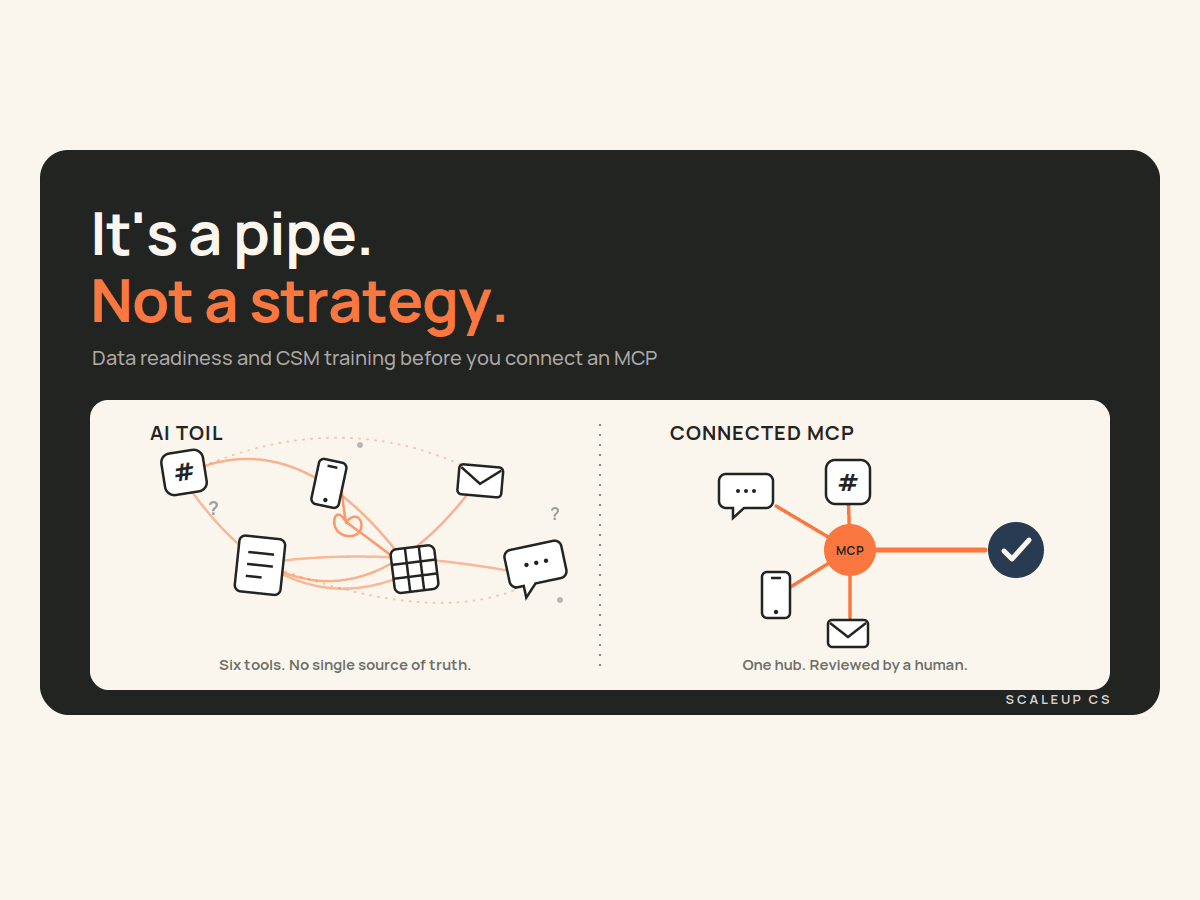
A CSP is an investment, no question. But over the long run, it will always be easier to buy one than to build and maintain one. And with MCPs in the mix, the old objection that "off the shelf won't fit how we work" doesn't hold up the way it used to. You can connect an existing platform to your AI tools and customize on top of it without owning the foundation underneath. Let someone else own the plumbing. Spend your team's energy on the part only you can do.
In full disclosure, we partner with both Vitally and Planhat, so weigh my take with that in mind. But my view on building isn't about which platform you pick. It's about what you're signing your team up to maintain for the next three years.
Here's what I'd do instead. Use Claude to build out your framework first: the health signals you care about, the plays you want to run, the loop you want between what you watch, what you learn, and what your CSMs do next. Prototype what you want a CSP to do for your team. Then use that to inform how you configure and build on the CSP you buy. You get the clarity of the build without the burden of owning it.
One speaker noted that "we'll just build it ourselves" was a real churn threat for software vendors earlier this year. I think that thinking will cool heading into Q4 and through Q2 of next year. I suspect a fair number of teams have tried this or are in the middle of testing this and are going to start running into the year two math. The math won't end up mathing.
There's still a lot of fear around what AI means for CSM jobs, and rightfully so. A lot of the people I spoke with were looking for their next role. One speaker cited McKinsey data that 39% of companies expect AI to reduce headcount within a year. That number isn't abstract when you're the one updating your resume.
What I heard on stage gave me some hope, though. On one panel, none of the three companies had autonomous agents running in customer facing CS, and two of them were growing CS headcount, not cutting it. One leader described how they reframed efficiency for their CFO: 30% revenue growth meant absorbing roughly 10,000 new customers with the team they already had. That's a growth story, not a layoff story, and CS leaders need to be the ones telling it before finance writes a different one.
But the role is changing shape, fast. Notion recast its CSMs and renewal managers as Outcome Architects. Lovable's CS leader talked about inspiring customer ambition instead of explaining the product. Another session described the "commercial operator" who spans the whole customer lifecycle instead of one slice of it.
The CSMs who come out ahead will function as three things at once:
Operators. You direct the AI, build and tune your own workflows, and catch it when the output is wrong.
Educators. You teach customers to do their own jobs better, using your product as the proof. Not which button to push. How to run their business better.
Commercial specialists. You own the renewal, the expansion conversation, and the pricing pushback, and you're comfortable doing it.
We can't sit back and assume the status quo will still be here in six months. It won't.
If you lead a CS team, this is the playbook we're using with our clients:
Start with the admin. Find where your CSMs' week actually goes and automate the busywork before you touch anything customer facing.
Define the problem before the demo. Write down the outcome you need before you take a single sales call or ask for budget.
Prototype in Claude, then buy the platform. Map the framework and plays you want first, then use that to configure a CSP you don't have to maintain. Name an owner for every workflow you add.
Decide what the time back is for before you get it. One speaker's ask of their exec team was two days a month per CSM to think and ship. Whatever your version is, make it intentional, or it quietly becomes more accounts per book.
If you're a CSM, don't wait for your company to hand you the new job description. Build one workflow of your own this month. Learn your customer's business, not just your product. And get comfortable in the commercial conversation, because that's where the job is heading whether your title changes or not.
One panelist said something I wrote down word for word: "it's never been easier to build a product, and it's never been harder to keep your customer". That's exactly why CSMs matter more right now, not less.
The teams that win this next stretch won't be the ones with the most agents or the most custom software. They'll be the ones that cleared the admin off their CSMs' plates, bought what they didn't need to own, and pointed their people at the work only people can do.
If you missed last month's session on what the CSM role looks like now, watch the full webinar replay here.