CS Operations
Your Team Trained the AI. Nobody Trained the Week.
 Nina Wilkinson

 Linnea Olson
When CS Ops leaves, the work that disappears is mostly invisible until it breaks, and at a lot of growth-stage SaaS companies, backfill isn't coming. Linnea Olson lays out how to hand off CS Ops like a self-serve product: audit playbooks and automations into Keep, Kill, and Simplify, pay down the tech debt that will break without you, build a key data points guide, and reroute the "hey, quick question" pipeline. Includes a four-week exit timeline and checklist.
You gave notice. Congratulations! Now comes the part nobody writes a LinkedIn post about: making sure your CS team doesn't fall apart the Monday after your laptop gets shipped back to IT.
If you've been the CS Ops person, you know the deal. You're the one CSMs Slack when a health score looks weird, when a playbook fires twice, when the renewal report "just broke," or when they need a list of every account with a QBR overdue by end of day, please and thank you. You are, for better or worse, their friendly neighborhood CS Ops person.
And here's the uncomfortable truth: in a lot of growth-stage SaaS companies, backfill isn't coming, or it's coming in a quarter or two, after a budget conversation you won't be part of. So the question isn't just "what tasks do I hand off?" It's "how do I leave so my CSMs can keep doing their jobs without me?"
The goal is simple: leave without leaving a mess. Here's how.
When a CSM leaves, their book of business gets reassigned. It's painful, but it's visible. When CS Ops leaves, the work that disappears is mostly invisible until it breaks.
Think about everything you do that isn't on a job description:
Quietly fixing the sync between Salesforce and your CS platform when a field mapping drifts
Tweaking a health score weight because one indicator got noisy
Pulling the "quick" churn-risk list every Monday for the team lead
Being the human search engine for "where does that number come from?"
Knowing that the Gainsight rule called "Copy of Copy of Renewal Alert v2" is, in fact, the one that matters
None of that is in a handoff doc yet. That's the point of the next few weeks: turn the stuff in your head into stuff in the system, and make the system simple enough that someone else can run it.
A good mental model: you're not handing off a job, you're handing off a self-serve product. Your CSMs are the users. Your job now is to ship v1.0 of "CS Ops, without the person."
Your playbooks and automations are the parts of CS Ops that keep working after you log off for good. Make sure they're worth inheriting.
Audit what's actually running. Export every active playbook, rule, and automation from your CSP (Vitally, Gainsight, ChurnZero, whatever you're living in). Then sort them into three buckets:
Keep: it fires, CSMs act on it, and it moves a metric
Kill: nobody acts on it, it duplicates something else, or it was built for a launch from 2023
Simplify: it matters, but it has seven branches and only you understand five of them
Be ruthless with the Kill pile. Every automation you leave behind is one more thing someone will have to troubleshoot without you. Fewer, clearer automations beat a clever web of them every time.
Rename like a stranger will read it. "RNL_60d_HS<50_v3_FINAL" made sense to you. To your successor, it's a name they'll skip right past. Use a naming convention that says what it does and who it's for: "Renewal – 60 days out – Low health – CSM task."
Give every playbook a one-paragraph "why." Most CSPs have a description field. Use it. Say what triggers the playbook, what the CSM is supposed to do, and what happens if they ignore it.
Assign a human owner. Every surviving automation needs a name next to it (usually the CS team lead or a senior CSM). Not to maintain it daily, but so someone knows it's theirs when it starts acting up.
Turn off the silent failures. Look for automations that fail quietly: webhooks to a deprecated Slack channel, Zapier zaps tied to your personal account, email sends from your name. Those die the day your SSO gets deprovisioned. Move them to a service account or shared owner now.
Every CS Ops person has a junk drawer. Yours probably includes fields nobody uses, segments built for one-off asks, and at least one integration held together with hope. You won't clean all of it. That's fine. Aim for "nothing that will confuse or break things."
Prioritize the debt that will cause the most pain without you:
Orphaned fields and traits. Hide or archive custom fields that no report, playbook, or view references. If a CSM sees 14 fields with "health" in the name, they will pick the wrong one.
Duplicate segments and views. Consolidate to one canonical version of each ("My Book," "Renewals Next 90," "At Risk"). Delete the rest, or at least prefix them "ARCHIVE –".
Fragile integrations. Document every sync: what system, which direction, which fields, how often, and what to check when it breaks. A one-line "if the Salesforce sync stops, check the integration user's password hasn't expired" can save someone a lost afternoon.
Hard-coded logic. Health scores with weights tied to a product that was sunset, renewal alerts based on a contract field Finance stopped filling in. Fix them or flag them loudly.
Permissions and admin access. Make sure at least two people have admin rights in every CS tool. You do not want your successor discovering the only admin login was yours.
Anything you can't fix, write down. A short "Known Issues" list is a gift. Unknown issues are a trap.
This is the one that saves your CSMs the most grief. For months (years?) they've asked you for numbers, and you've pulled them. Once you leave, the numbers don't stop being needed. The person who knew where to find them does.
Start by scrolling back through your Slack DMs and request channel. Every "hey, can you pull…" is a line in your guide. Then build a simple table like this:
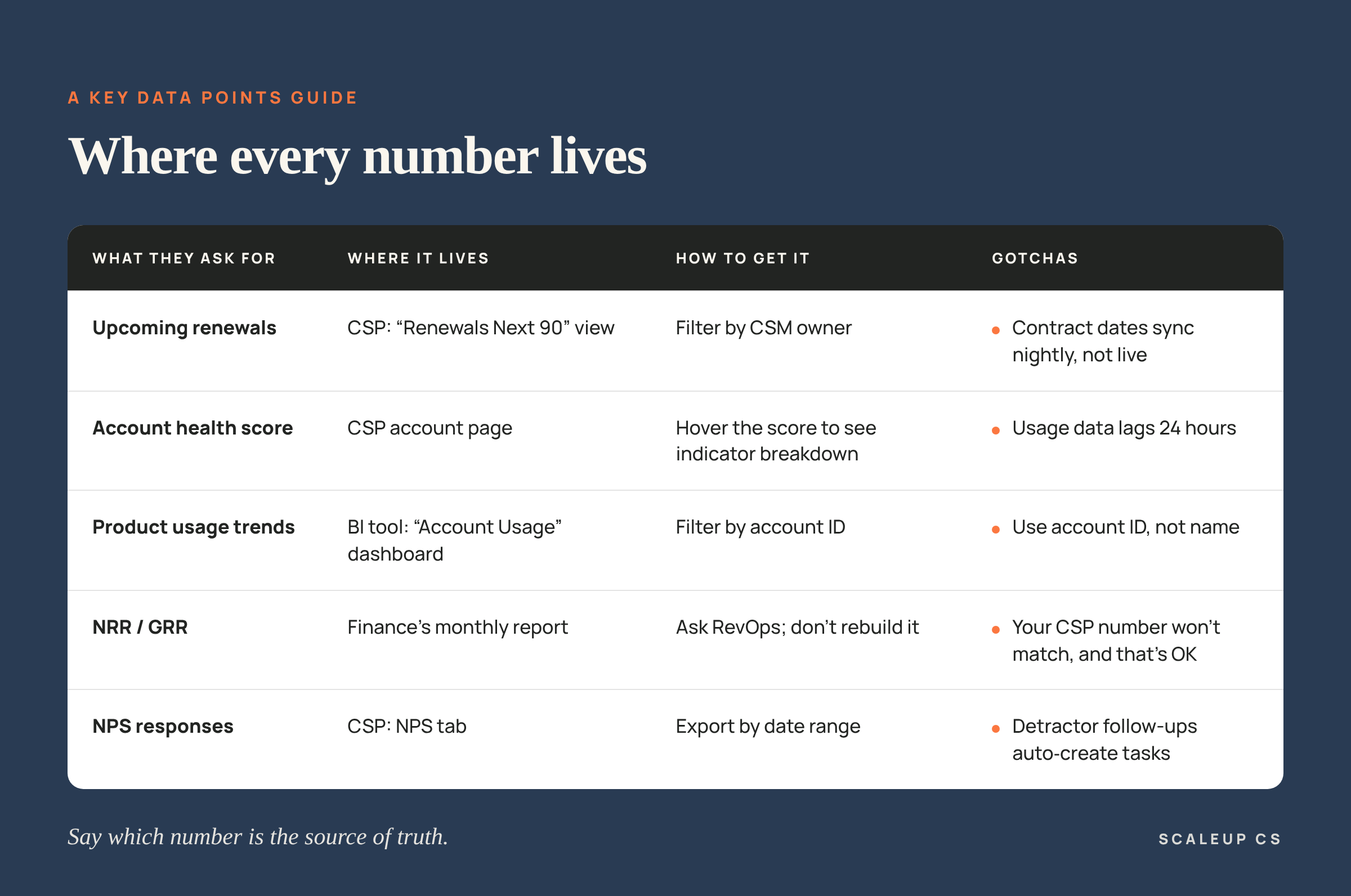
A few tips that make the guide actually get used:
Write for the least technical CSM on the team. Screenshots and Loom videos beat paragraphs.
Link to the saved view, not the tool's homepage. One click to the answer.
Say which number is the source of truth. If the CSP and Finance disagree on ARR, say who wins.
Teach them to fish. Hold one or two working sessions where CSMs pull their own reports while you watch. Confidence is half the handoff.
If you already have a CS data dictionary, this guide is its friendlier, task-based cousin. Pin it somewhere obvious, like the team Slack channel and the CSP's resource page.
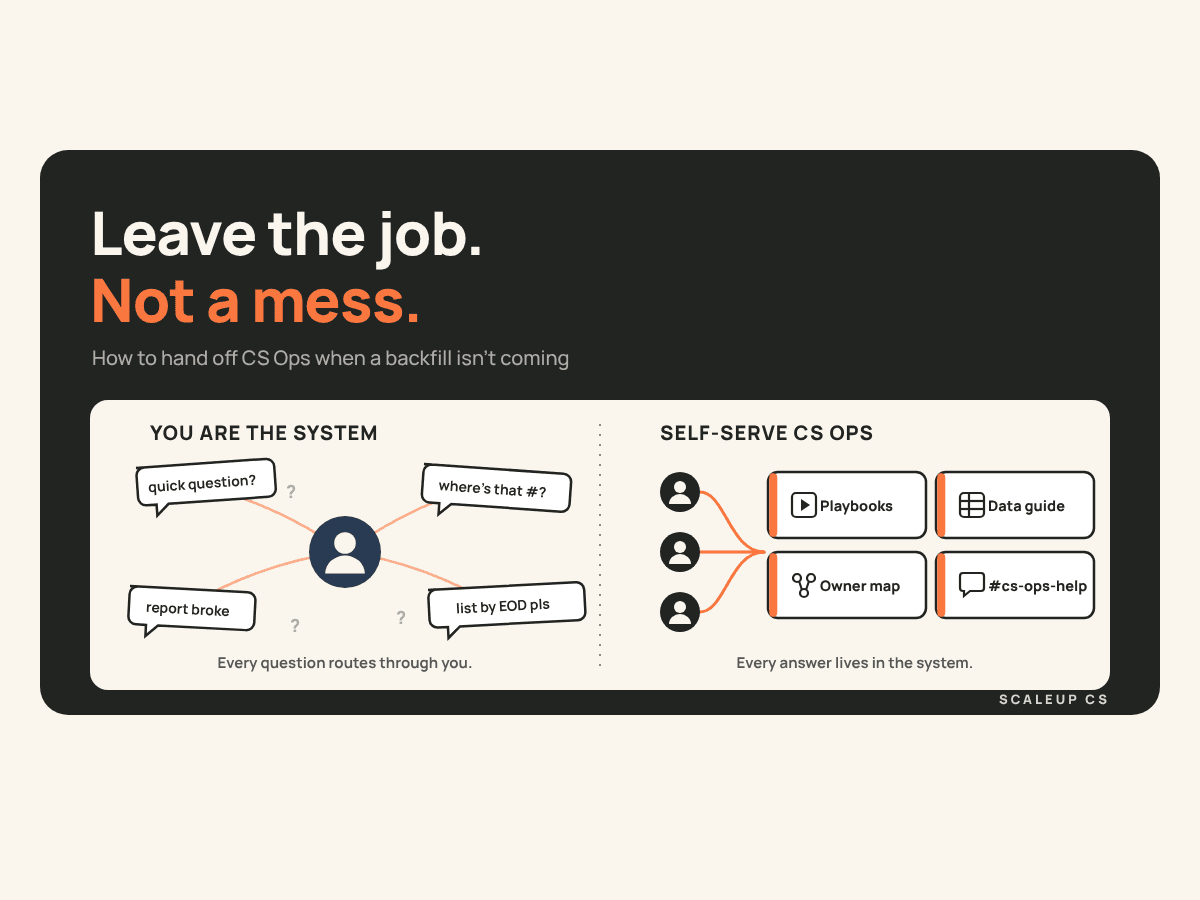
Your CSMs have a habit, and it's you. The day after you leave, someone will open Slack, type your name, and find nothing. Give that habit somewhere new to go.
Build an ownership map. One simple table: every CS tool, report, and recurring process, with who owns it now. Include the boring stuff, like who approves new CSP seats and who renews the contract.
Pick a front door for requests. A Slack channel (#cs-ops-help), a form, or a Jira/Asana queue. Start routing requests there before you leave so the habit forms while you're still around to answer.
Name a "first responder." Usually the team lead or the most systems-curious CSM. They don't need to know everything, just where the docs are and when to escalate to RevOps or IT.
Write down what can wait. Not everything needs fixing right away. A short "safe to ignore for 90 days" list keeps the team from panicking when a minor rule misfires.
Hold office hours in your last two weeks. Open time where anyone can bring a question. You'll uncover the tribal knowledge you forgot you had.
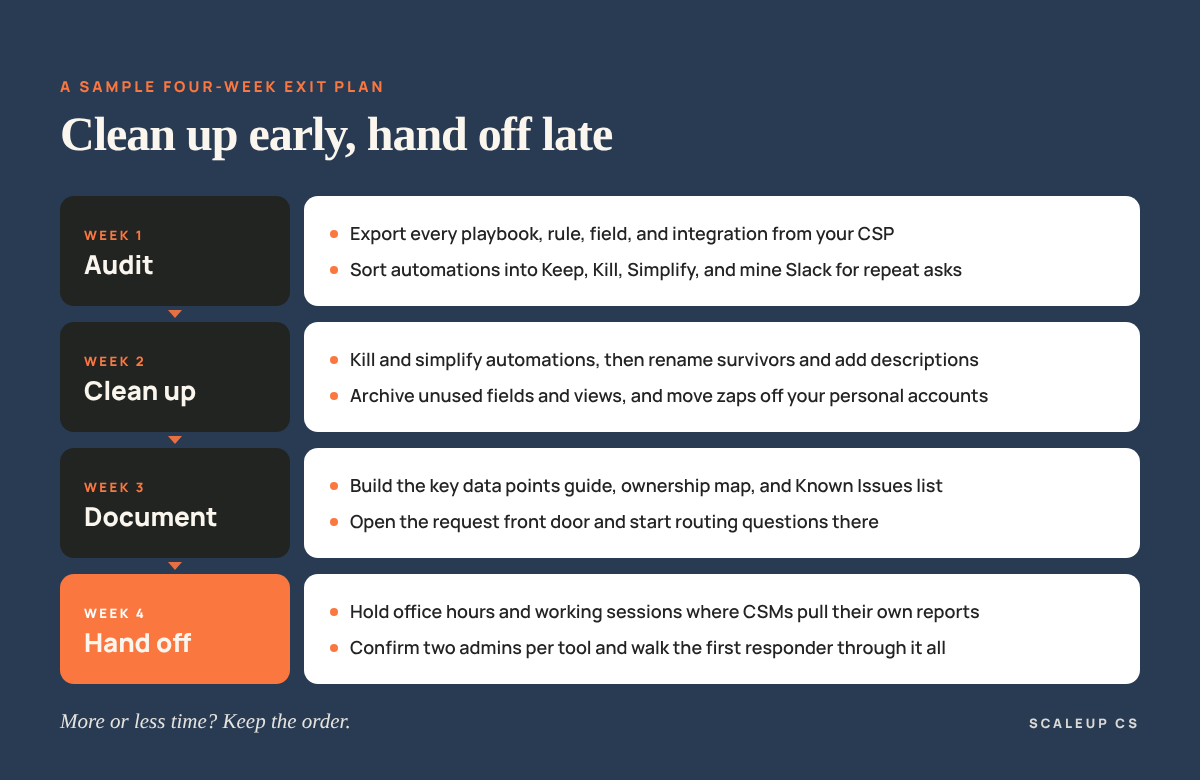
More or less than four weeks? Keep the order. Audit and clean up while you still have time to fix what you find, and save the handoff for the end so your CSMs get real practice before you're gone.
The best compliment a departing CS Ops person can get is silence: no frantic Slack messages two weeks later, no "do you remember how…" texts, no broken renewal alert nobody noticed until a customer churned.
You can't plan for everything, and that's OK. But if your CSMs have clean playbooks, a lighter tech stack, a guide to their data, and a clear place to send questions, you've done right by them. And you'll start your next role without that nagging guilt about the team you left behind.
Your exit checklist:
Active playbooks and automations audited (Keep / Kill / Simplify)
Survivors renamed, described, and assigned an owner
Automations moved off your personal accounts
Unused fields, segments, and views archived
Every integration documented, including what to check when it breaks
Two or more admins on every CS tool
Known Issues list written
Key data points guide built, pinned, and walked through with the team
Ownership map shared
Request front door live, with a named first responder
Office hours held
Now go enjoy that new job. You earned it, and so did your CSMs.