CS Leadership & Team Building
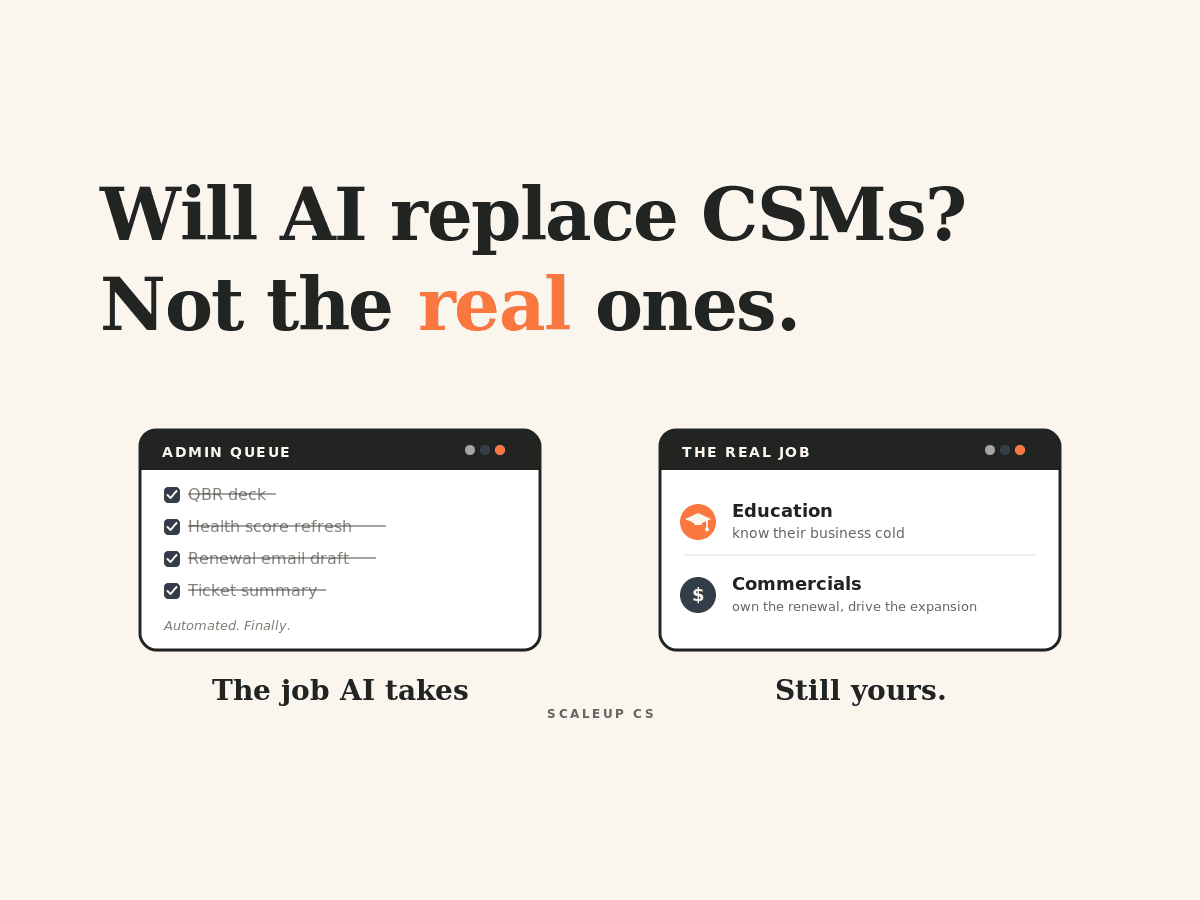
Will AI Replace CSMs? Only the Ones Who Were Never Actually Doing the Job.
 Nina Wilkinson
 Nina Wilkinson
Most CS teams have already trained their AI on their own sales and product content. Almost none have written down how the week is supposed to run. This piece shares the five-day CSM cadence we rolled out with a client on Vitally, why every day's focus should be something your data can filter for, how Linnea turned that cadence into a working day plan with Claude and MCP, and the steps CS leaders can take this month.
Two numbers from last week's webinar have been stuck in my head since the session ended.
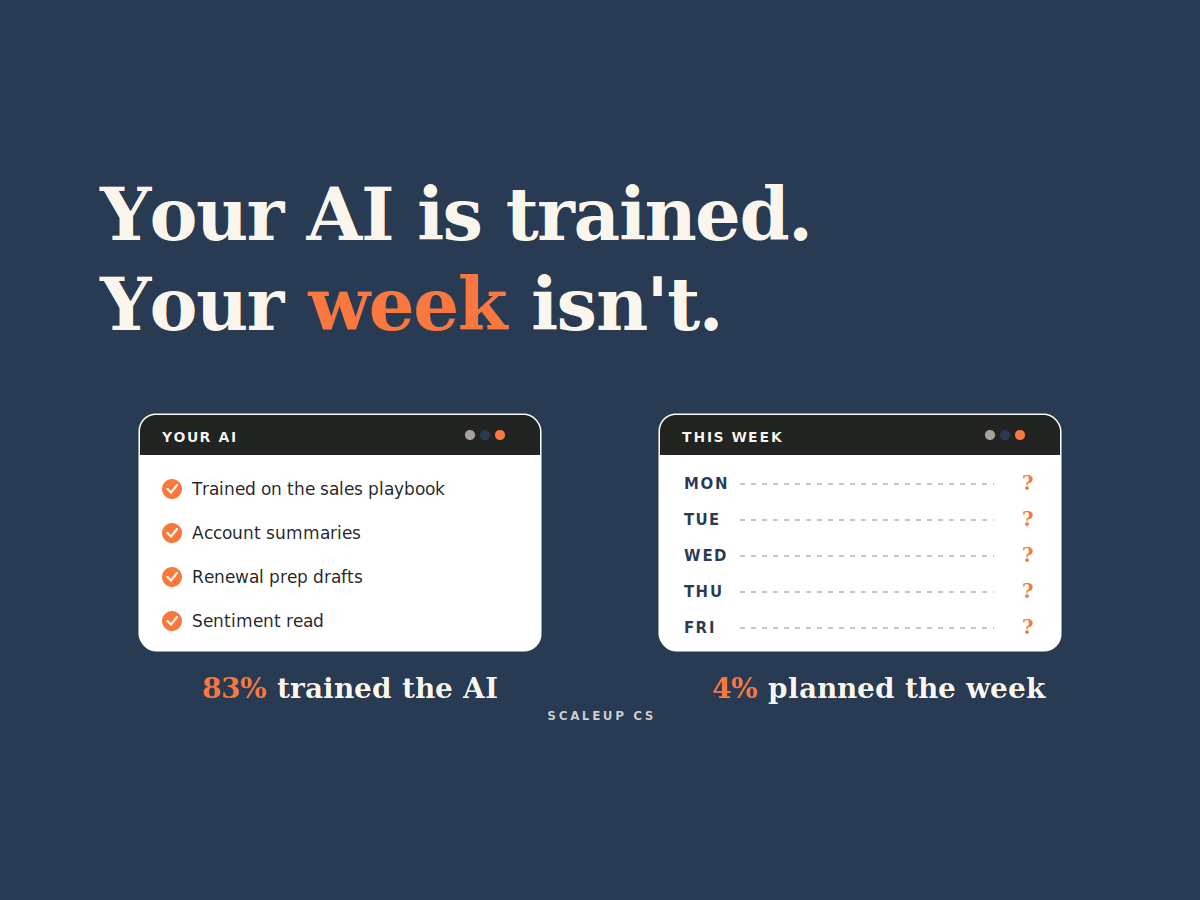
During our session on the CSM role rewrite, Linnea and I asked roughly 100 CS and revenue leaders how their teams are working with AI. 83% said they already customize AI tools with their own company's sales or product content, and do it regularly. Then we asked whether their team has a structured way to plan the day. Only 4% said yes, a formal framework everyone uses. 55% said everyone plans their own day. Another 25% said it's mostly tribal knowledge.
So the tools are trained. The week isn't.
And this wasn't a skeptical crowd. Anyone who shows up to a webinar called "From CSM to AI Orchestrator" is probably ahead of the market on AI. If the most AI-forward teams in the room are running their days on memory and habit, I'd bet the rest of the market looks the same or worse.
Picture a CSM with a really good AI setup. Their account summaries pull from the real sales playbook. The renewal prep drafts itself. The sentiment read is sharper than anything they'd write by hand.
Then they open their laptop Tuesday morning and decide what to do based on whatever's loudest in the inbox.
That's the gap. All that trained output lands in a day that's still improvised, so it gets used when someone remembers to use it. And when the plan lives in people's heads, we see the same symptoms on almost every team we work with:
Everyone "knows" what Mondays are for, but nobody wrote it down
New CSMs learn the cadence by watching, not by reading it anywhere
The plan lives in one person's head, not in the tool
Consistency depends on who trained you
That last one is the expensive one. If your best CSM's rhythm walks out the door with her, you never had a system. You had a person.
Earlier this year we helped a client's CS team move off spreadsheets and onto Vitally. The dashboard was the easy part. The piece that actually changed how the team worked was a single slide in the training deck: how do we organize our week?
Here's the version we rolled out:
Monday: customers entering the renewal period, and customers 90 days post onboarding. Prep for upcoming renewal calls and make sure new customers are hitting time to value.
Tuesday: at-risk customers in renewal. Open renewal engagement, churn and downgrade saves, escalation management.
Wednesday: at-risk customers in adoption (red health). Re-engage accounts with poor or declining usage, account planning, and scheduled cadence calls.
Thursday: monitoring yellow health and adoption. Account planning, cadence calls, and outreach to low adoption accounts before they turn red.
Friday: healthy account planning and data hygiene. Keep the green accounts green and growing, close out notes and follow ups, and update renewal statuses.
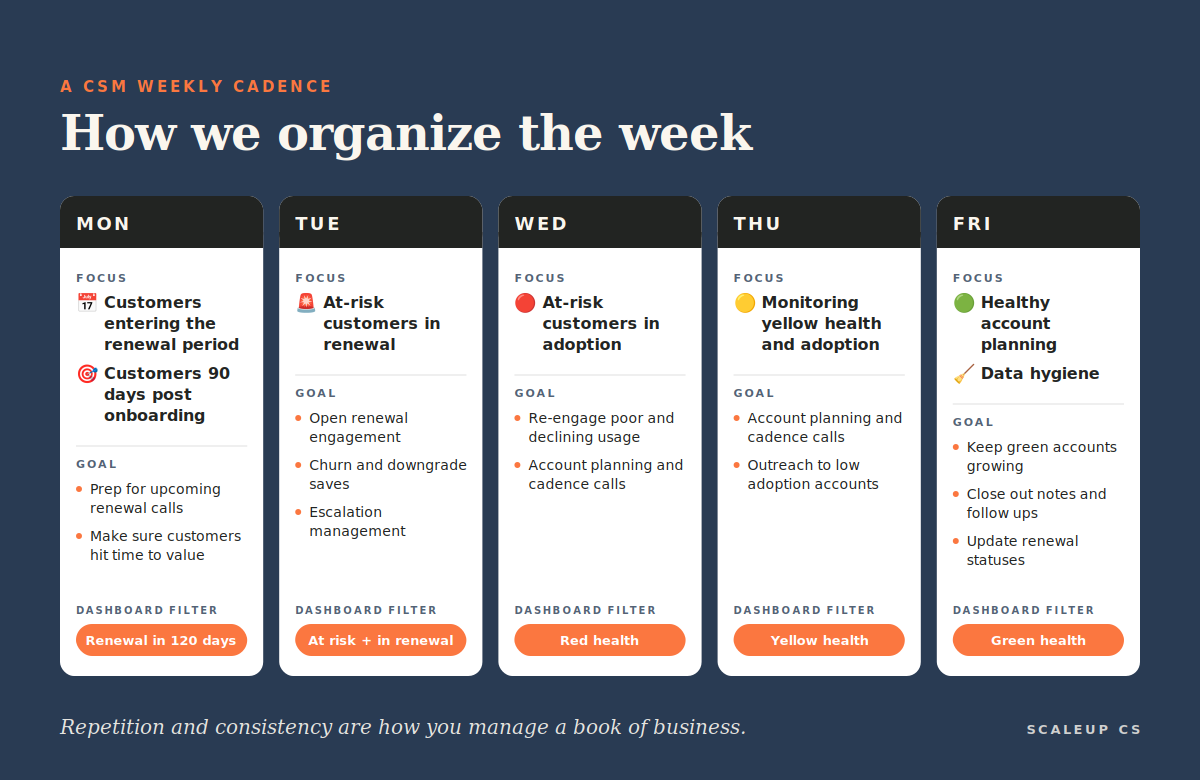
The line at the bottom of that slide said it better than I can: repetition and consistency are how you successfully manage a book of business. A routine keeps you organized, keeps you focused, and stops the context switching that eats a CSM's week.
Notice what every day has in common. Each focus is something the data can answer. "Customers entering the renewal period" is a filter. "Red health in adoption" is a filter. "Yellow health" is a filter. We didn't design it that way because we were planning for AI. We designed it so the dashboard could tell a CSM where to start every morning, and so managers could run the weekly 1:1 off the same view. That's exactly what makes it ready for AI now.
Here's why the written version matters more once AI enters the picture. An AI tool can only follow a plan it can read. If Monday's priorities live in your head, there's nothing to connect it to. If Monday's priorities are "accounts 120 days from renewal, plus anything 90 days post onboarding," that's a query.
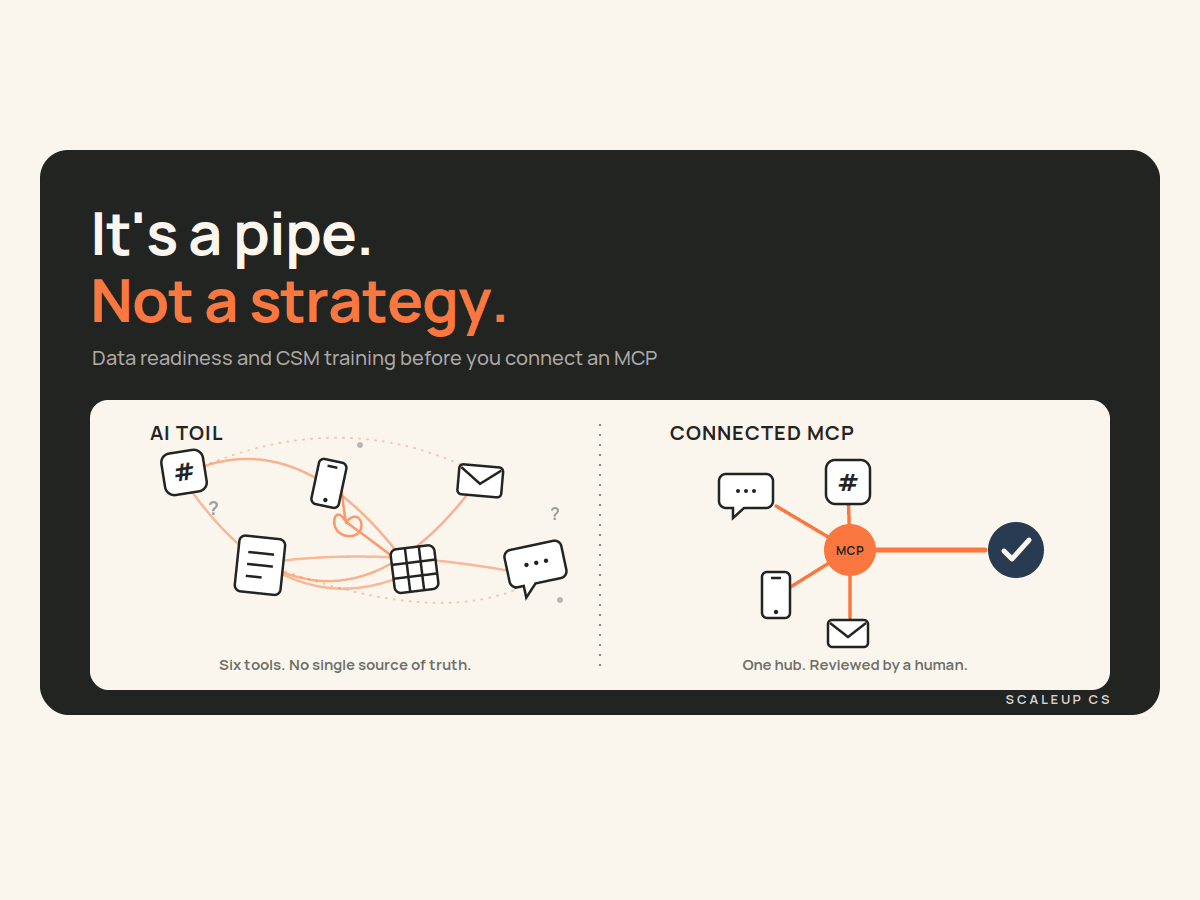
This is what Linnea has been building, and she's running it on her own book right now before it goes anywhere else. She connected Claude to Vitally through MCP and turned the weekly cadence into a working day plan. Every morning it does four things:
Pulls today's priorities. At-risk accounts, renewals, and follow ups owed, based on which day of the cadence it is.
Drafts the prep. Account context comes in ready, so nothing starts from a blank page.
Sequences the day. Tasks get ordered by urgency and account tier, not by inbox order.
Flags what needs a human. Anything ambiguous gets surfaced instead of decided.
Because the MCP connection is a live query, not a monthly export, the numbers reflect what's happening in Vitally right now. Nobody's rebuilding a pivot table on Friday afternoon to find out what they should have done on Wednesday.
Same cadence. Different reliability. The tribal knowledge version works as well as the person running it. The working system runs the same way for the CSM who's been on the team four years and the one who started last week.
The pushback I hear is that a framework like this turns CSMs into ticket processors. It doesn't, and it's worth being specific about why.
Most teams have two kinds of strong CSM. The relationship-strong CSM has high trust, high retention, and customers who ask for her by name, but her follow ups slip when the week gets busy. The structure-strong CSM rarely misses a beat and is always on top of the queue, but sometimes leans procedural over personal.
The framework's job is to close the specific gap each person has. For the relationship-strong CSM, it's the scaffolding that catches what she'd otherwise drop. For the structure-strong CSM, it takes over the queue management she's already good at and frees up time for the conversations that don't come as naturally. AI doesn't replace what either of them does best. It supports what they don't.
If you lead a CS team, this is the playbook we're using with our clients:
Write the week down before you automate it. One page. Five days. What each day is for and what "done" looks like. If your team can't agree on it, that's your first finding.
Make every focus a filter. If a day's priority can't be answered by your CS platform, rewrite it until it can. "Check in with at-risk accounts" isn't a filter. "Red health, renewal inside 120 days" is.
Run your 1:1s off the same view. If the cadence and the 1:1 agenda pull from different places, the cadence becomes optional within a month.
Connect it once it's stable. Test it on one book first, fix what doesn't hold up on a real week, then roll it out to the team.
Update the job description to match. The competency isn't "executes the weekly workflow reliably" anymore. It's "directs the AI on that workflow, and catches it when the output is wrong." If your leveling guide still describes the old version, it's grading a job that no longer exists.
If you're a CSM on a team without a framework, don't wait for one. Take the five days above, adjust them to your book, and run it for a month. You'll learn more about where your week actually goes than any time audit will tell you.
Most teams have already done the hard part. They've trained their AI on their own playbook, and they're using it regularly. What almost nobody has done is the easy part: write down how the week is supposed to run. Until that exists, all that well-trained output lands in a day that's made up as it goes, and consistency depends on who trained you instead of what you built.
If you missed the session, watch the full webinar replay here.