Retention & Churn
Do AI-Driven Health Scores Actually Predict Churn Better?
 Nina Wilkinson

 Nina Wilkinson
Under seat-based pricing, a customer could use 160 of 200 seats and still renew. Under outcome-based pricing, unrealized value becomes unrealized revenue, often by the next billing cycle. Yet most CS teams still run playbooks built on logins and feature adoption. This piece covers why the old playbook breaks, the 3 shifts CS has to make (starting with a value contract at kickoff), and the guardrails CS Ops needs to build now.
For most of saas history, the renewal math was forgiving. A customer bought 200 seats, used maybe 160 of them, and renewed anyway because nobody in finance had looked closely at the per seat cost. A tool nobody used could ride on autopilot for a year or two before anyone asked the hard question.
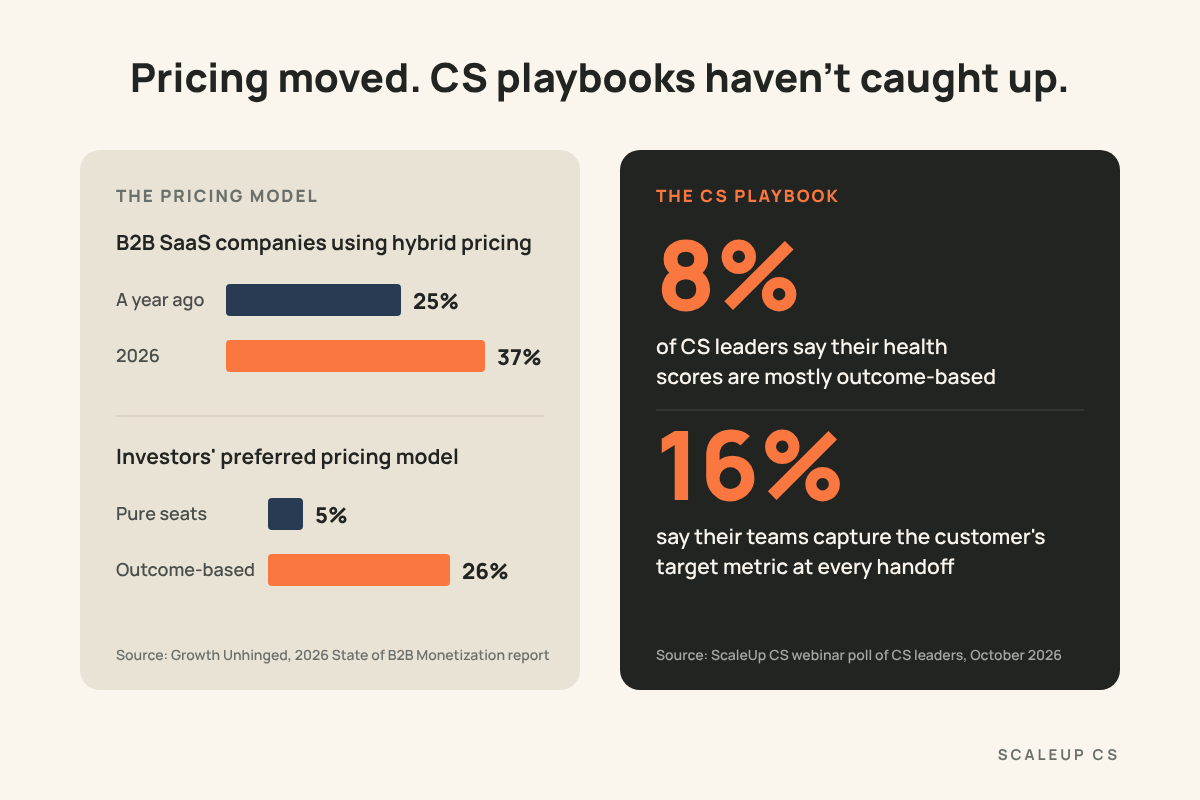
That math is changing fast. Hybrid pricing (some mix of seats, platform fees, usage, and AI consumption) jumped from 25% to 37% of B2B SaaS and AI companies in a single year, according to Growth Unhinged's 2026 State of B2B SaaS and AI Monetization report. When the same report asked companies which pricing model investors prefer, only 5% picked pure seat-based. 26% picked outcome-based.
Seats aren't gone. But they're no longer the whole story, and for a growing share of revenue the deal is simple: if the customer doesn't realize measurable value, you don't get paid. Not at a renewal 18 months from now, at the next billing cycle.
As Gainsight put it, "unrealized value for the customer becomes unrealized revenue for the vendor."
Here's the tension I keep seeing with our clients. CROs and CCOs are changing the pricing model in the boardroom, while CS teams are still running 2022 playbooks built on login frequency, feature adoption, and relationship sentiment. The pricing model moved. The operating model didn't.
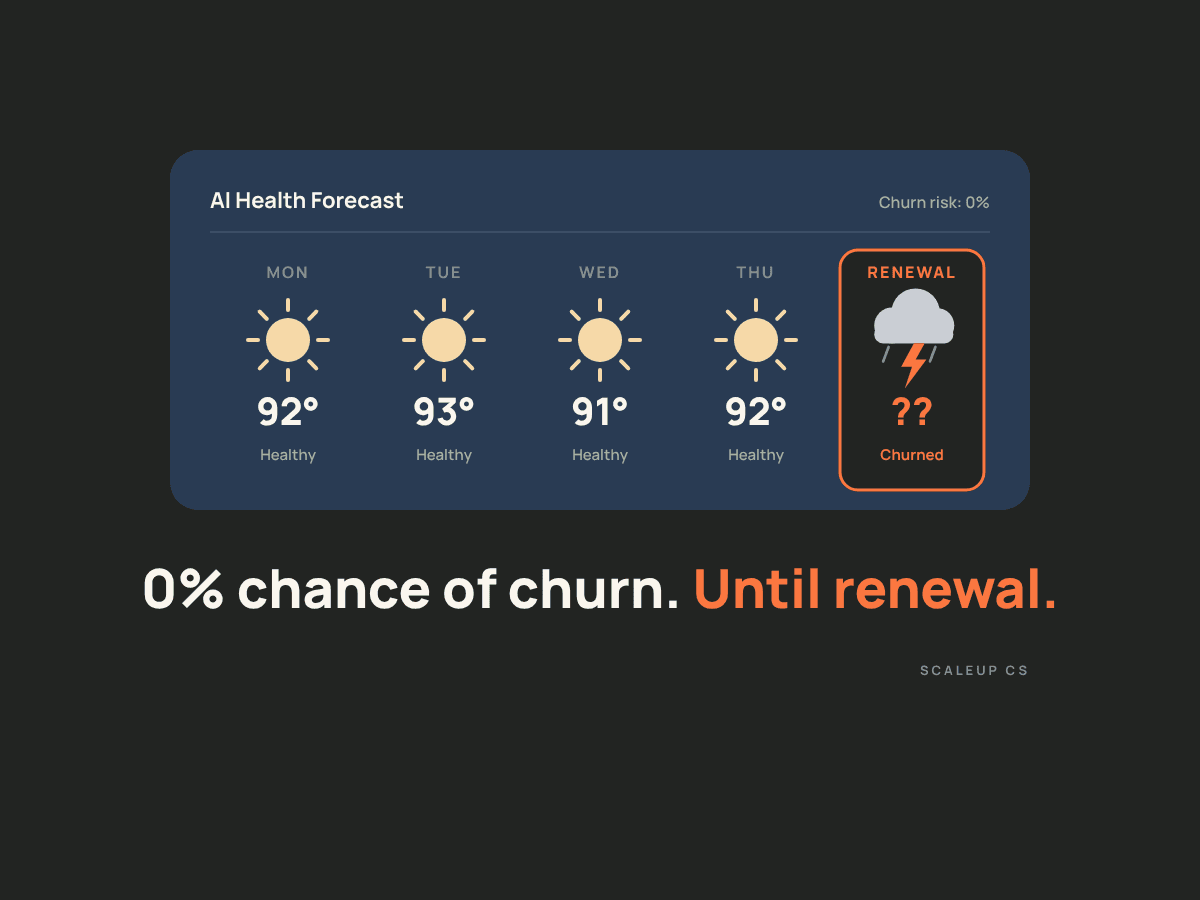
Clicks, active seats, and AI prompt volume tell you the product is being used. They don't tell you it's working. A customer can run 10,000 automated workflows and still see zero new pipeline or zero hours saved. Under seat pricing, that was a churn risk down the road. Under outcome pricing, it's a revenue problem this quarter.
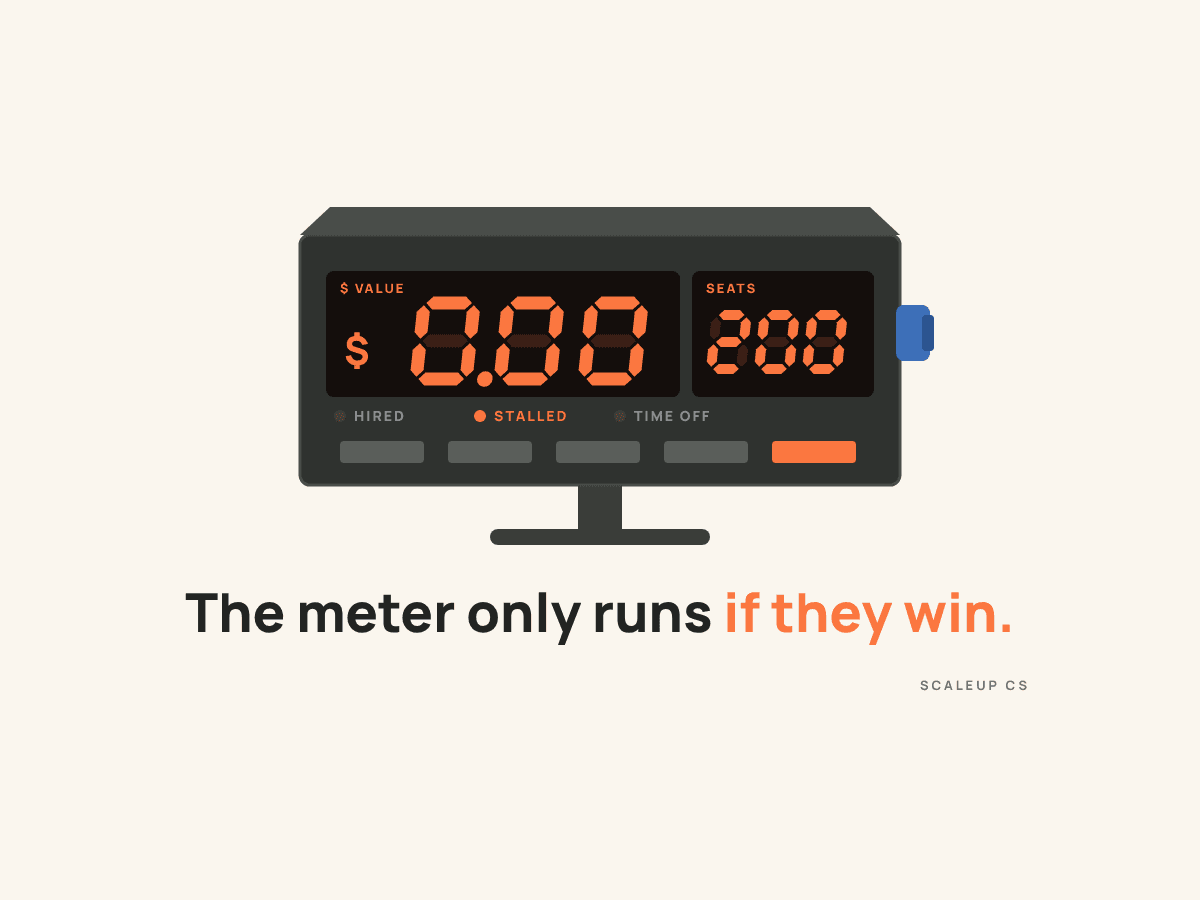
We've all done it: 60 days before renewal, the CSM scrambles to pull together an ROI story from whatever data exists. That was never a great plan. Now it's an even worse one. When revenue tracks usage or results, the billing meter has already stalled by the time you're building that deck.
Your product claims to save hours, reduce churn, or generate revenue. Great. Does the customer's CFO agree with your math? If not, the renewal turns into a negotiation over definitions instead of a conversation about value. And you won't win a definitions fight with someone else's finance team.
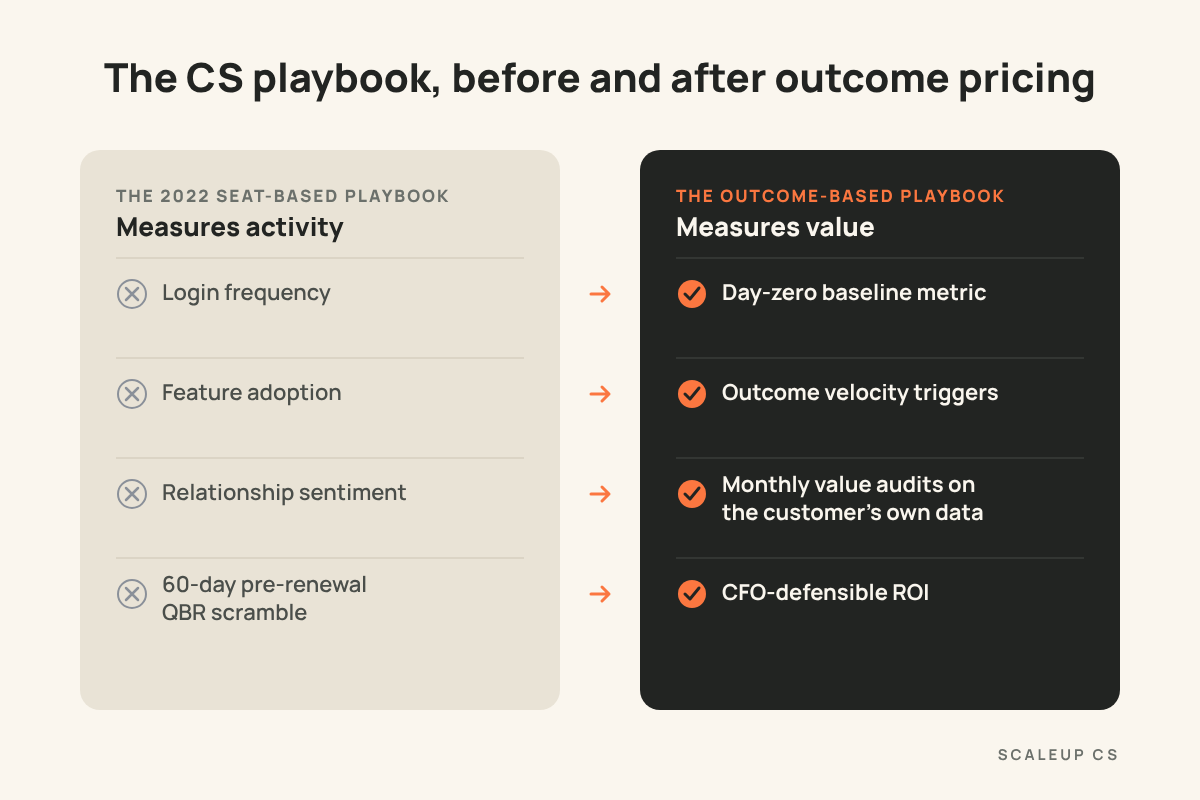
Here's the playbook we're using with our clients.
Think of it as a value contract. Sales and CS hand off a single, mutually agreed baseline metric on day zero. For example: current ticket resolution time is 14 hours, and the target outcome is under 4 hours within two quarters.
Sales sells the dream. CS delivers on the reality. Outcome pricing just means the reality now shows up on the invoice.
Most teams aren't there yet. In our October webinar poll, 40% of CS leaders said their teams rarely or never capture the customer's target business metric at handoff. Only 16% do it for every account. If CS has to invent the success metric in month six, you've already lost.
Only 8% of the CS leaders we polled said their health scores are mostly outcome-based. That has to change when outcomes drive revenue.
Replace generic engagement scores with outcome milestones:
Time to first automated workflow
Data integration completeness
Validated time or cost saved per week, confirmed by the customer
Then build early-warning triggers on outcome velocity. If the customer's progress toward their target slows down, you want to know long before usage drops. By the time usage drops, so has the revenue. (We went deep on activity vs. outcome metrics in The Death of Vanity Metrics.)
Relationships still matter. But under outcome pricing, a great relationship with a customer who can't prove ROI is a pleasant conversation on the way to a downgrade or worse, a full churn.
Run value checkpoints on the customer's data. Monthly or quarterly, using their internal numbers, not your vendor dashboard.
Speak the CFO's language. Baselines, cost per outcome, payback period. CSMs need to be fluent in all three.
Own the commercial conversation when results stall. Equip CSMs to handle pushback when usage or outcomes plateau, and partner tightly with Sales or Account Management on expansion triggers when outcomes accelerate.
This isn't about turning CSMs into sales reps in sheep's clothing. It's about making them the people who can prove the value the customer is paying for.
Playbooks fall apart without infrastructure behind them. Three things to build now:
Standardized ROI calculators. Give every CSM a repeatable, CFO-defensible framework for measuring outcomes. If every CSM builds a custom spreadsheet, you end up with 12 versions of the truth and none of them hold up in a renewal negotiation.
A hard gate on the Sales-to-CS handoff. No deal closes on an outcome-based tier without a documented baseline metric and a named customer data owner. No baseline, no outcome pricing. It's a simple rule, and it'll save you a lot of painful renewals. Hold your Sales reps accountable here.
Comp plans that match the revenue model. If CSMs are paid purely on gross retention while revenue moves with usage and outcomes, your incentives point the wrong way. Tie variable comp to net dollar retention or verified outcome milestones. You can't incentivize your way out of a structural problem, but you can stop paying people to solve the wrong one.
Pricing models are changing faster than CS operating models. Outcome-based monetization removes the safety net of passive renewals, and that makes CS the primary engine of revenue realization, not just post sales support.
The good news: CS teams that already define value at kickoff, measure it with the customer, and prove it on a regular rhythm don't need a new playbook. They just need everyone else to catch up.
Where is your team on this? Has your company started moving away from seats, and has your CS playbook changed with it? Reply or drop a comment. I'd love to hear what you're seeing in the trenches.