Sales–CS Alignment
We Asked 41 CS and Revenue Leaders About Their CSM/AM Roles. Here's What They Told Us
 Nina Wilkinson
 Nina Wilkinson
Revenue leaders are no longer satisfied with CS tracking customer happiness. Survival and growth hinge on NRR, but most CS teams haven't been built to move commercial pipeline. This is the blueprint for scaling CSQLs, structuring expansion playbooks, and building shared revenue quotas, regardless of whether you sell a point solution or a multi-line product suite.
For a long time, CS lived in the fuzzy world of "customer happiness," tracking metrics like CSAT and NPS. But sentiment doesn’t pay the bills. In the current macroeconomic climate, revenue leaders and founders have realized that survival and growth hinge entirely on NRR.
I want to be clear, if your CS org is still reporting NPS to the board as a proxy for commercial health, that's not a CS problem. That's a structural problem in how you've set the team up.
We know the adage, “Sales sells the dream. CS delivers on the reality.” But delivering on the reality only matters commercially if your CS team is wired into the expansion motion from the start. I promise you, your board isn’t going to be satisfied with CS just acting solely as a defensive shield against churn. They want CS aligned directly with the commercial pipeline.
The challenge isn’t the desire to do this; it’s the execution. How do you turn usage spikes, product data, or new executive relationships into a repeatable, high-intent expansion engine?
Depending on your product architecture, whether you sell a point solution or a multi-line product suite this is the blueprint for scaling CSQLs, structuring playbooks, and building shared revenue quotas that work for our clients.
First, Define What a CSQL Actually Means for Your Business Model
Customer Success Qualified Leads (CSQLs) are the currency that connects CS to your commercial pipeline. But how you track and scale them depends entirely on your product architecture. I see two distinct patterns, and conflating them is where most teams we’ve been helping have gone wrong in the past.
You cannot scale CSQLs with a one-size-fits-all approach. Your strategy must map directly to how your product is packaged and consumed.
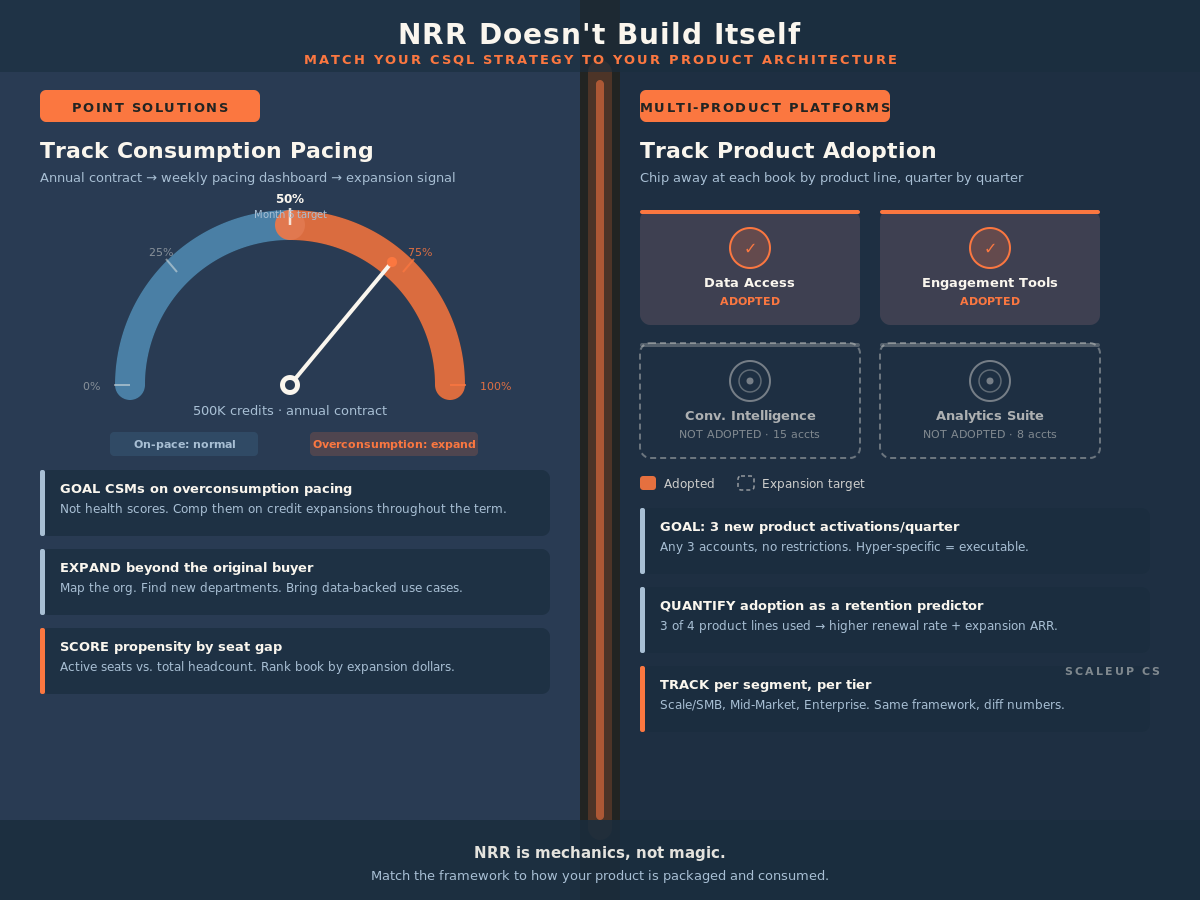
When I was building out the CS org at Lob, their contracts were structured around a flat API license fee plus batches of credits. That model gave us a precise lever to pull.
The Operational Framework: If a customer signs an annual contract for 500,000 credits, they should ideally hit ~250,000 credits by month six. We built internal dashboards to track this consumption pacing weekly.
The CSM Goal: CSMs weren't goaled on abstract health scores; they were goaled on overconsumption pacing and comped on driving credit expansions throughout the contract term.
The Playbook: To hit these numbers, CSMs couldn't just talk to their primary point of contact. They had to map the organization to find other departments that could utilize the platform (e.g., expanding from traditional marketing teams into transactional or operational teams), while actively bringing data-backed recommendations for new campaigns and use cases to the table.
When you have multiple product lines, the play changes entirely.
At Apollo, the product structure was different. Customers came in through data access. That was the tip of the spear. But the real expansion opportunity lived in the product lines they hadn't activated yet. Linnea and I built a tracking framework in Vitally to show each CSM their book's product adoption by line.
The Operational Framework: We tracked individual product usage at the account level inside Vitally. If a strategic CSM managed 35 accounts, and an audit showed that 15 of them weren't using our Conversation Intelligence product, we gave them a concrete, tactical target.
The CSM Goal: I goaled the CSM to get 3 new customers to adopt that specific product line within the quarter. I didn’t care which three, as long as there were no technical restrictions blocking them. By making the goal hyper-specific and micro-targeted, it was easy for CSMs to execute practical adoption plays.
The Predictive Data: In parallel, we partnered with our Analytics team to analyze product adoption as a predictive marker for retention health. We looked at the numbers: If a customer buys 4 total product lines and actively uses 3, what is their renewal rate and average expansion ARR? The data proved that multi-product adoption directly correlates with lifetime value, giving the CS team a clear mandate.
In parallel, I ran analysis with the BI team to understand product adoption as a retention predictor. If Apollo had 4 product lines total and customers using 3 of them showed materially higher renewal rates and expansion throughout their term, that's not a hypothesis. That's a number you can take to your board and build comp structures around. The more product lines a customer is embedded in, the stickier they are and the more they expand. Quantify that relationship. Then goal your CSMs against it.
This one gets overlooked more than it should. If you have data on your customers, use it. At Apollo, we dogfooded our own platform to calculate upsell propensity.
If a customer like Dunder Mifflin had 10 active seats on our platform, we used Apollo's database to look up how many total sales reps actually worked at Dunder Mifflin. If they had 50 reps total, we tracked that 40-seat delta. We then ranked our entire customer base from greatest to lowest delta in terms of "expansion propensity dollars," giving CSMs a prioritized hit-list of accounts ripe for seat expansion. No more fumbling through your list of customers to figure out who to approach for an upsell.
If your product gives you intelligence about your customers' businesses, use it. You have data sitting in your own platform that your CS team isn't touching. That's free signal for expansion propensity.
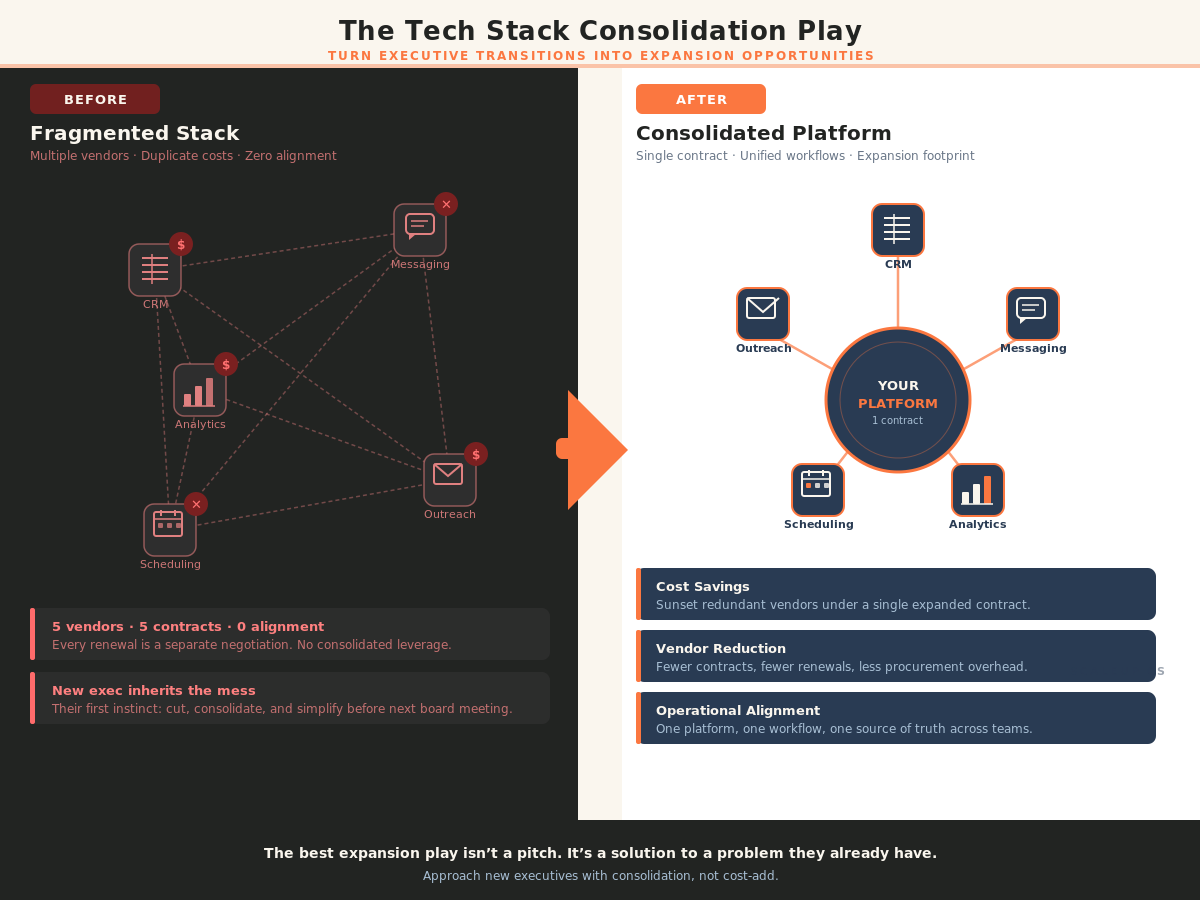
While usage data is a fantastic trigger for expansion, human transitions are equally powerful. The goal is to turn executive engagement into expansion opportunities.
The best time to run an expansion play is when a new executive (C-level or VP) takes over an account.
A new leader enters an organization with a mandate for change, a fresh budget, and zero historical baggage. They don't care about past friction your team might have had with their predecessor. More importantly, in today’s market, every new executive is looking for ways to cut costs and optimize operations.
The Playbook: Do not send a "Congrats on the new role, let's chat" email. Instead, initiate a Tech Stack Consolidation Play.
Approach the new executive with a comprehensive review of how your platform can replace other fragmented tools in their ecosystem. Position your multi-line product or expanded seat tiers not as an added expense, but as a cost-saving measure to sunset competing vendors. You are offering them a way to simplify their workflows, consolidate vendor management, and save money (sometimes significant sums think 1 or 2 headcount even), under a single contract. For more on our tech stack consolidation plays we ran at Apollo, check out this post.
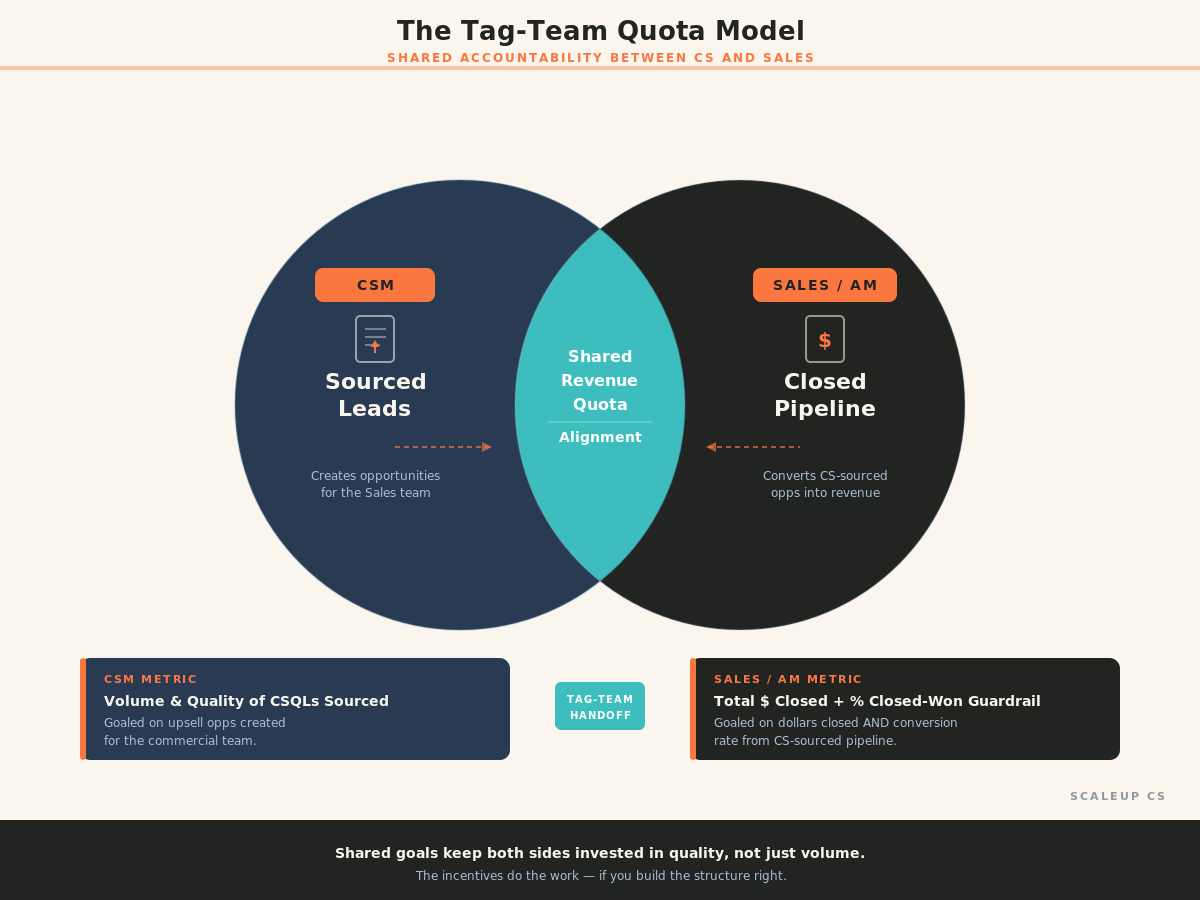
The tag team structure between AEs/AMs and CSMs is where most companies fall apart. They set targets independently and then wonder why expansion credits are contested and handoffs are broken. So to make post-sale expansion repeatable, you have to align incentives across Sales (AEs/AMs) and CS.
Here's how I've structured it:
CSMs are goaled against the number of upsell opportunities they create for the commercial team.
Sales/AMs are goaled on the total dollar amount closed from that specific pool of CSQLs.
This structure keeps both sides invested in the quality of opportunities, not just the volume. A CSM bringing weak leads loses credibility with the Sales team fast. A Sales rep who ignores CS-sourced pipeline loses comp. The incentives do the work.
That said, this isn’t always picture perfect.
While this looks beautiful on a slide deck, implementing it comes with major operational friction. If you don't design the process carefully, you will encounter two massive roadblocks:
The Black Hole of Sales Follow-Through: CSMs get excited, generate high-quality opportunities, hand them off, and... nothing happens. AEs get distracted by new business, and the CSQLs sit untouched.
The CRM De-Duplication Trap: A CSM surfaces an expansion lead. Meanwhile, an Account Manager opens a generic renewal or upsell opportunity in the CRM. To keep the CRM clean, Operations de-duplicates the pipeline, frequently deleting the CS-created opportunity. Suddenly, the CS team's impact is completely erased from the data.
To be completely frank, when we first ran this, it wasn't as clean as it could have been. I found myself manually reconciling every single open CSQL at the end of every month, cross-referencing it with Sales, and pushing sales leadership to ensure their reps were following up in a timely fashion.
I literally had to have a weekly meeting with our head of the AM team at Apollo to go through every. single. CSQL. What we found was helpful in that we had AMs who were blindly ignoring ops, or others who weren’t following opp creation properly in SFDC. It ended up solving a few issues that were lurking beneath the surface, not just missed revenue.
To save yourself that manual headache, you should implement these guardrails from day one:
Audit-Proof CRM Routing: Set up strict validation rules in your CRM (like Salesforce or HubSpot). If an AM/AE creates an expansion opportunity on an active account, force a mandatory field that asks, "Was this sourced by CS?" Ensure your multi-touch attribution tools credit the original CSQL tag, even if opportunities are merged.
The Conversion Rate Guardrail: Don't just goal Sales on closed-won dollars. Goal your sales reps on the percentage of closed-won opportunities created by CSMs. Why? Because if you only look at total dollars, one massive account win can artificially hide the fact that a sales rep ignored 15 other high-quality leads generated by your CS team. Keeping them accountable to a conversion rate ensures every lead gets respected and vetted.
Tiered Targets: Break down your targets by segment. Your Scale/SMB team should have a high-volume target for total opportunities created and a smaller aggregate dollar amount. Your Mid-Market and Enterprise/Strategic teams should have tightly focused, high-dollar targets.
Operationalizing NRR is about taking the guesswork out of the post-sale motion. By matching your CSQL strategy to your product type, jumping on executive transitions with a consolidation narrative, and building a tightly governed, mutually accountable handoff between CS and Sales, you turn Customer Success from a cost center into a predictable revenue engine.
It’s not always clean, and it requires continuous leadership alignment, but the impact on your NRR makes the operational grind entirely worth it.