Sales–CS Alignment
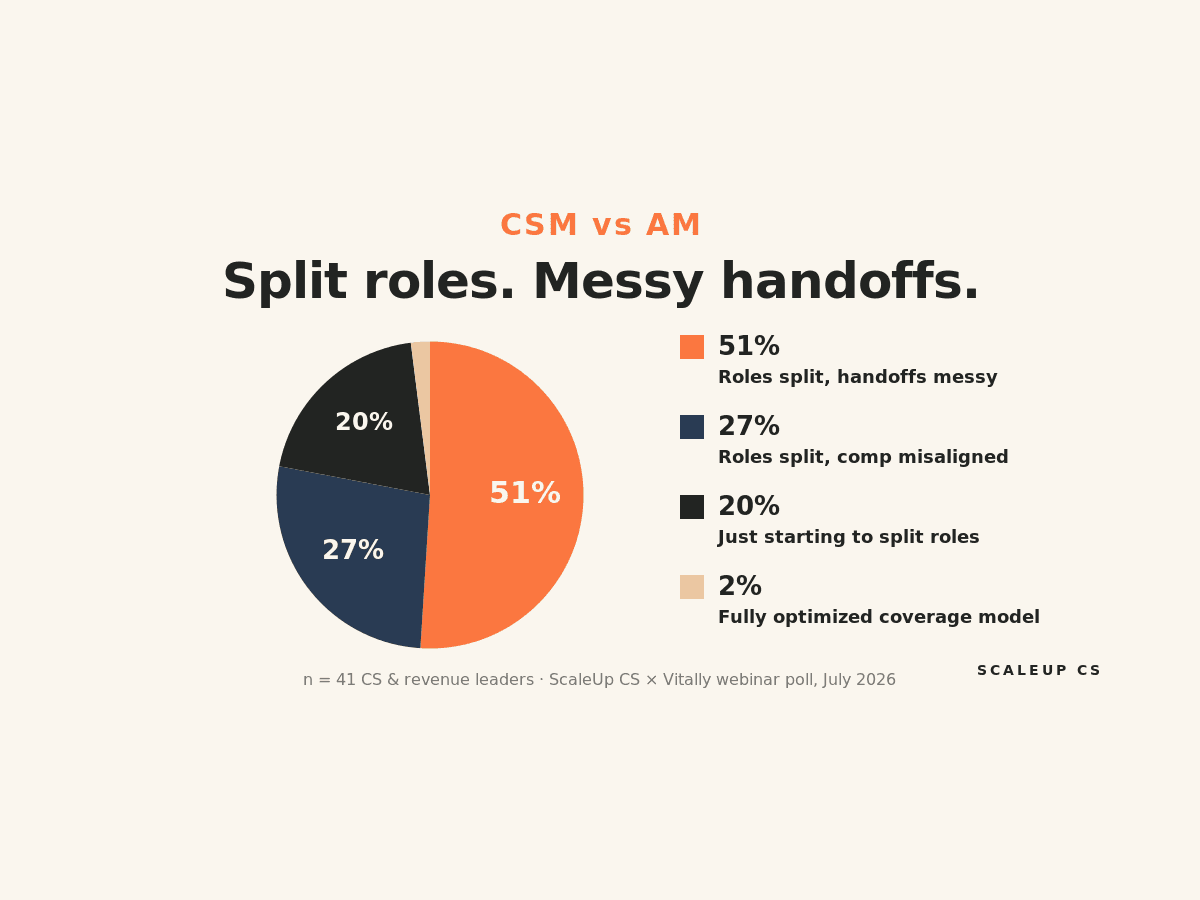
We Asked 41 CS and Revenue Leaders About Their CSM/AM Roles. Here's What They Told Us
 Nina Wilkinson
 Nina Wilkinson
If you're moving upmarket and your CSMs are not in the room before the contract is signed on your biggest logos, you are leaving win rate, retention, and net revenue on the table. The pre-sales CSM is one of the highest-leverage plays in B2B SaaS, and one of the most underused. When to deploy it, when in the deal cycle to bring the CSM in, the exec sponsor and quarterback structure that scales, and how AEs and CSMs share credit on these deals without a turf war.
If you're moving upmarket and your CSMs are not in the room before the contract is signed on your biggest logos, you're leaving win rate, retention, and net revenue on the table.
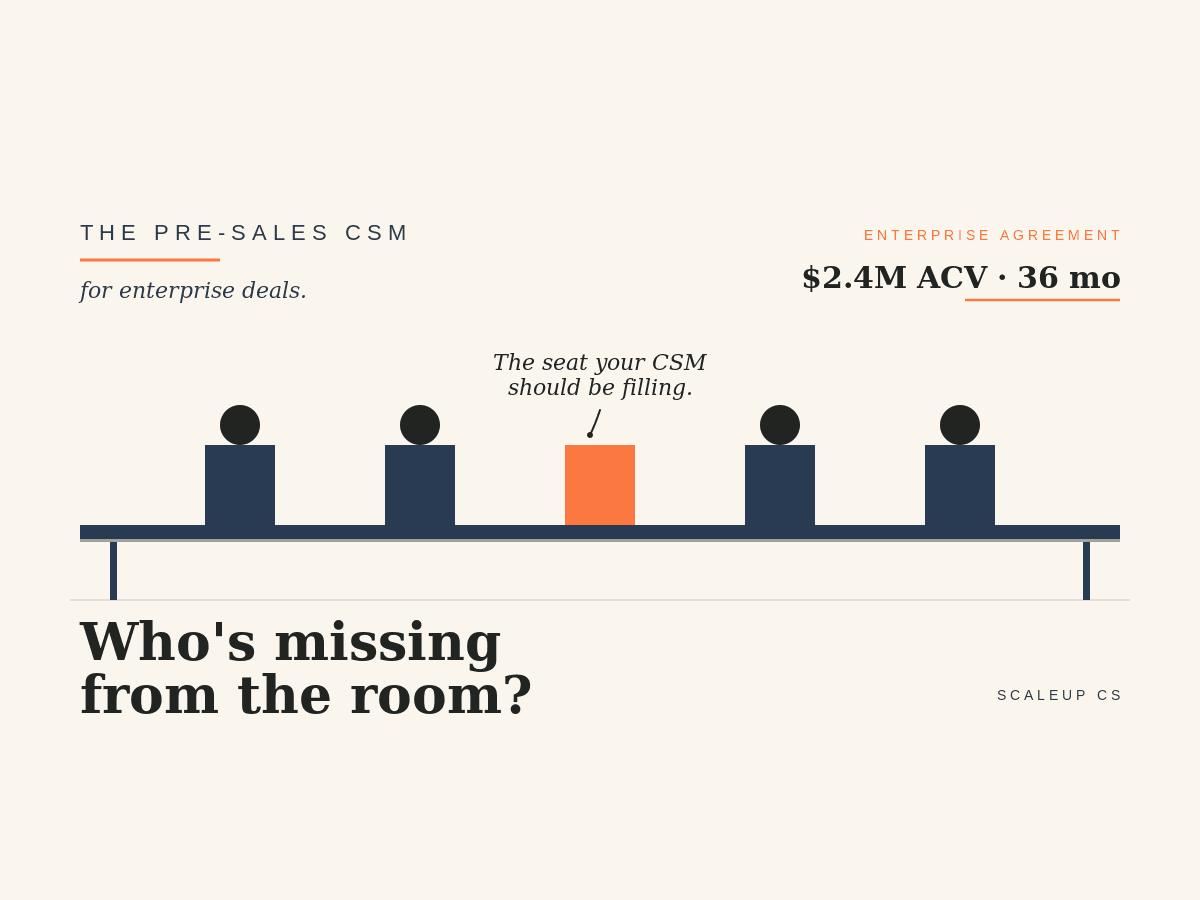
The pre-sales CSM is one of the most underused plays in SaaS, and it is also one of the highest leverage. When you are chasing an F500 logo where the implementation will run four to six months and the relationship will define your category position for the next three years, the moment your CSM meets your customer matters. If that moment is the kickoff call, you have already lost three months of runway you needed.
This is the playbook we use with clients moving from MM into Strat and Ent. It is not a default for every deal. It is a focused, disciplined investment in the small number of accounts where the cost of getting it wrong is structural.
Let's be clear up front. This is not "every CSM joins every late-stage deal." That is the fastest way to torch your CS team's productivity, blow up your comp structure, and turn your CSMs into pre-sales engineers in disguise.
This play is for high-value targets only. The mission critical logos. The accounts where:
The contract value justifies dedicated executive engagement
The implementation will run longer than your typical onboarding cycle (four to six months, not four to six weeks)
The relationship is meant to last multiple years, with material expansion baked into the model
Losing the deal, or worse, winning it and watching it churn, would be a public, board visible problem
For every other deal, the standard sales-to-CS handoff still applies. We wrote the framework for that here.
The cap matters. We tell our clients: one to two pre-sales engagements per Strat or Ent CSM per month, maximum. Their primary book has to stay primary. The pre-sales work is additive, not a substitute. If you find yourself running this play five times a quarter per CSM, you do not have a pre-sales CSM problem. You have a CSM headcount problem, and that is a different conversation.
The pre-sales CSM is not running the demo. They are not closing the deal. They are not on every call.
What they are doing, sitting alongside your AE in the late stages of an Ent cycle, is the work that pays off after the contract is signed. There are four moves that matter, and they all happen before signature.
Learning the origin of the relationship. Why is this customer talking to you in the first place? What was the failed prior solution? Who got fired or promoted because of it? What does the buyer's career risk look like if this implementation goes sideways? The CSM needs to walk into kickoff knowing the backstory, not asking for it.
Mapping the major players. Decision maker, economic buyer, technical evaluator, day-to-day user, and the executive sponsor on the customer side who is going to need to be cultivated and kept warm long after the AE has moved on. The CSM should walk out of the sales cycle with a map of who matters and a working relationship with at least the day-to-day user and the technical lead.
Surfacing implementation risk back to product and engineering. This is a hidden benefit founders miss. Your CSM is the one person on the deal who is thinking about the next eighteen months, not the next ninety days. They will spot the integration that is going to be painful, the data hygiene problem that will derail go-live, the change management gap nobody on the sales side is incentivized to flag. Get that signal into product before the deal closes, not after.
Cultivating the relationship before commercials are on the table. This is the part most founders miss. By the time you are negotiating a contract, the customer has built rapport with your AE. They have built nothing with anyone they will work with for the next three years. The pre-sales CSM is the one closing that gap so that day one of the contract is not day one of the relationship.
One quick disambiguation worth making, because this role gets confused with another one constantly. The pre-sales CSM is not a Sales Engineer. The SE (or Solutions Consultant, depending on your nomenclature) owns technical fit. They run the architecture conversation, answer the security questionnaire, and prove the product can do what your AE promised. They typically rotate off the deal at signature. The pre-sales CSM is doing none of that. They are not selling, not validating product fit, not closing. They are the person who will own the customer relationship for the next three years, and their job in the sales cycle is to listen, to be present, and to start building a working relationship with the people they will partner with after signature.
The clearest way to think about it: the SE makes sure the deal can close. The pre-sales CSM makes sure the deal can succeed. If you have an SE motion already, this does not replace it. They sit on the deal together, with different jobs.
The timing matters as much as the engagement itself. Bring the CSM in too early and they are sitting through demos and discovery calls that drain their primary book. Bring them in too late and you have lost the runway you needed to build a real relationship.
The right window is after the initial discovery and validation calls, as the deal moves into the start of the technical evaluation. The CSM does not need to be there for the first demo. They do need to be in the room the first time the actual decision maker joins a call.
Here is the pattern most enterprise deal flows follow. The first conversation is almost never with the person who will sign the agreement or spend the budget to support the project. It is with a day-to-day user, a front-line manager, or a technical evaluator. Discovery and product validation happen with that group. Then, as the deal escalates, the economic buyer and executive sponsor on the customer side get added to a later call. That moment, when the buyer and the customer's exec sponsor enter the conversation, is the moment your CSM needs to be in the room.
Here's why that specific call. That is when the customer's leadership starts forming an opinion about your company. It is when commitment language gets used. It is when the customer's exec is sizing up not just the product but the team that will be on the other end of the relationship. If your CSM is not there to start building rapport with the customer's exec at the moment they enter the deal, the AE is the only face of your company they will associate with the partnership. That is fine for the close. It is not fine for the renewal.
A practical rule: the CSM enters the deal cycle one calendar week before the first call that includes the customer's economic buyer or executive sponsor. They use that week to read the existing call recordings, sync with the AE, and prepare specific questions to bring into the room.
When the CSM is in the room, they are not running the demo and they are not closing. They are listening for the things the AE is not incentivized to flag and the customer is not going to volunteer. Three questions earn their keep more than any others.
1. "What does a win look like for you in twelve months, and who on your side gets the credit or the blame?" This question surfaces the customer's executive sponsor's actual stake in the outcome. It is a question your AE cannot ask without sounding like they are managing for the renewal, but a CSM can ask it as a mark of seriousness about delivering value.
2. "What is the one part of this implementation you are most worried about?" Your AE is incentivized to make this sound easy. The customer is incentivized to sign and figure it out later. Neither side gets clarity on the real implementation risk unless someone whose job is the next eighteen months, not the next ninety days, asks the question directly.
3. "Who on your team is going to use this every day, and what do they think?" Decision makers buy. Day-to-day users decide whether the product survives the first quarter. If the day-to-day user is unhappy or absent from the buying process, your CSM needs to know now, not in month four.
These three questions also do something else. They quietly signal to the customer that there is a person in this company whose entire job is the success of the implementation, not the closure of the deal. That signal lands hard at the executive sponsor table, and it is one of the reasons this play moves win rate.
When I was at Lob, we ran this play with our two largest enterprise logos at the time: Verizon and Capital One. Both deals had implementation timelines that stretched well past a quarter. Both had multi-year contracts. Both were the kind of accounts where, if we got the relationship right, the next three years took care of themselves, and if we got it wrong, we would be writing recovery plans for the same three years.
The structure we used has held up everywhere I've deployed it since.
Two CS people are the primaries on the account, both involved before signature.
The Strategic CSM is the quarterback. They are the day-to-day owner of the relationship from the moment they enter the sales cycle. They are the one in the implementation working sessions, the one the customer's project lead calls when something is off, the one running the actual playbook. They never leave the account once they are on it.
CS leadership is the executive sponsor. That was me at Lob. At your company it might be your VP of CS, your Head of CS, or the founder if you are early stage. The exec sponsor is the air cover. They sit across from the customer's exec team. They make sure the customer's executive sponsor is heard at every turn. They keep your own exec leadership informed and aligned, so when the customer's CIO calls your CEO, your CEO already knows who they are and what they need.
The quarterback runs the plays. The exec sponsor builds and maintains the relationship at the leadership tier. And critically, the two of them keep product, engineering, and the broader exec team informed about risks and challenges as they surface, so nothing about the implementation is a surprise to anyone internal.
What you are really building, when you put this in place across your top accounts, is an executive sponsor program. Same play, repeated, with the same structure across every Strategic and Enterprise logo in your portfolio. That is the thing that compounds.
Here is the threshold most teams miss.
If your contract is multi-year and your implementation is four to six months, this is critical.
Without it, you spend the first six months of a three-year relationship watching your CSM build rapport with people who already feel disconnected from the company they bought from. You will get there eventually, but your first expansion conversation will land six months later than it should, which means your NRR forecast will land six months later than it should.
If your contract is annual and your implementation is four to six months, this is mandatory. Full stop. You do not get to spend one to two months building the relationship before procurement starts their renewal review. You will lose those deals.
Run the math. A four-month implementation on a one-year contract leaves you two months of normal operating relationship before the customer's procurement team opens the renewal file.
Two months is not enough time to build trust deep enough to weather the first inevitable bug, the first feature gap, the first executive sponsor change on their side. The customer signed a one-year contract with a sales team they trust and a CS team they barely know. That is the math problem. The pre-sales CSM is how you solve it.
This play does not work if your AE feels watched and your CSM feels punished.
Start with the AE side. AEs are wired to own their deals. The instinct, when you tell them a CSM is going to be in their late-stage calls, is to assume someone is checking up on them. The way you dissolve this is to be explicit with the AE about the role: the CSM is not there to run the deal, validate the technical fit, or weigh in on commercial structure. The CSM is there because this customer is going to be a multi-year, multi-million-dollar relationship, and the buyer needs to see the team that will deliver on it. The AE is still the deal owner. The CSM is staffing for the relationship that starts after the contract is signed.
The CSM side is harder, and most companies get it wrong. Strategic and Enterprise CSMs are typically compensated on retention, expansion, and NRR within their book. Time spent in the sales cycle is, structurally, time not spent driving those numbers. If you do not address this, the play creates exactly the dysfunction it is meant to avoid: your most senior CSMs treating pre-sales work as homework that lowers their bonus.
Two fixes. First, the deals the pre-sales CSM contributes to should land in their book at signature, with full retention and expansion credit. The work they did in the sales cycle was the relationship investment in their own future book. Make sure the comp structure recognizes that. Second, set the cap explicitly in their goals and have CS leadership defend it. One to two pre-sales engagements per CSM per month is a real time commitment, and the CSM needs to know that hitting that bar is part of what they are measured on, not in addition to it.
The AE conversation is structural. The CSM conversation is structural and commercial. Get both right and the play scales without political damage. (For more on how to compensate Strategic and Enterprise CSMs in a way that supports this kind of play, see our CSM compensation playbook.)
If you are a CCO, CRO, or founder looking at this and thinking "great, but my Strategic CSMs are already maxed out," here is the order of operations.
Start with the deals that fit the bar. Pick your top two or three Strategic or Enterprise opportunities in pipeline this quarter. Not the ones most likely to close. The ones whose loss would hurt the most.
Define the cap explicitly with your Strategic CSMs. One to two pre-sales engagements per CSM per month. This needs to live in their goals and in their compensation conversations, so they are not penalized in their primary book for time spent in the sales cycle.
Get sales leadership to gate it. The AE does not get to invite a CSM into a deal unilaterally. Sales leadership and CS leadership need to agree that the deal meets the bar, the CSM has capacity, and there is a defined moment for the CSM to enter (typically after discovery, before final commercial negotiation). Without a gate, this turns into "every AE wants a CSM in their pitch," and you are back where you started.
Brief the customer. The CSM is introduced as the leader of their success after signature, not as a sales engineer. The customer should understand that this person will be there long after the AE moves on. That framing alone changes how the customer engages with the CSM in the late stages of the deal.
Track win rate and time-to-value separately on these deals. The pre-sales CSM motion costs you something. Make sure you are measuring what it earns you. In our client engagements, Strategic deals run with a pre-sales CSM consistently close at a meaningfully higher win rate than comparable deals without one, kick off within a week of signature instead of the standard three to four weeks, and produce their first land-and-expand conversation months earlier. If your numbers do not move that direction, your bar is wrong, your structure is wrong, or your CSMs are getting pulled into deals that do not fit the play.
Three patterns I've watched companies fall into.
The CSM gets pulled in too late. The AE thinks of the CSM as the person who shows up after the deal closes, not before, and only loops them in once the contract is in redlines. By that point the customer has built rapport with the AE, the implementation manager, and procurement, but not with the CSM who is about to own the relationship. The CSM walks into kickoff exactly the same way they would have without the play. You spent the time and got none of the value.
The exec sponsor goes silent after signature. The CS leader was in the late-stage exec calls, made the right impression, then disappeared into other accounts. The customer's executive sponsor remembers the exec sponsor on your side as the person who promised executive engagement and now cannot get a meeting. The first time their CIO needs to escalate something, they call the AE, who can no longer help. Trust dies fast.
The customer gets confused about who owns what. Two senior people on your side enter the deal in the late stages with no clear delineation of roles. The customer cannot tell who is the day-to-day partner and who is the executive cover. Decisions stall because the customer does not know who to escalate to. The fix is naming roles explicitly to the customer in the late-stage call: this is your day-to-day partner, this is your executive sponsor, here is what each is for, here is when to call which one.
The unifying pattern in all three is the same. This play is not a sales tactic. It is a structural commitment to the relationship that has to be honored after signature. If the rest of the org cannot support what the pre-sales CSM is promising, the play is worse than not running it.
For the one or two strategic deals per CSM per month that define your category, your customer success team belongs in the sales cycle, not waiting on the other side of it.
The exec sponsor and quarterback structure is what makes this scale without breaking the rest of your CS org. The cap is what protects your CSMs' primary books. The bar is what keeps this play from turning into a default.
Sales sells the dream. CS delivers on the reality. For the deals that define your category, you do not get to wait until the contract is signed to start that conversation.